Understanding Brain Mapping on the Gold Coast
Health, Brain Mapping, qEEG Assessment, Gold Coast
What’s Happening When We Do a Brain Map?
What actually happens when we do a brain map? If you are considering a Brain & Nervous System Assessment, you may be curious about what takes place in the room, what the sensors are doing and what happens to all that brainwave information. The process can sound technical, but in practice it is designed to be simple, comfortable and highly informative. At Neurotherapy Australia on the Gold Coast, brain mapping is about helping you understand your own brain and nervous system patterns in a clear, practical way.
What Is a Brain Map?
A brain map is a way of recording and analysing the electrical activity produced by your brain. The technical name for this process is quantitative electroencephalography, often shortened to qEEG brain mapping. “Electroencephalography” simply means measuring electrical activity from the brain, and “quantitative” refers to using numerical analysis to examine that activity in more detail.
Your brain is constantly active. Billions of nerve cells (neurons) communicate with each other using tiny electrical signals. When many neurons fire together, they create patterns of activity that can be detected at the scalp as brainwave activity. These patterns can change depending on what you are doing and how you are feeling – for example, whether you are focused, relaxed, drowsy or stressed.
During a qEEG assessment, small sensors are placed on your scalp to record this activity. The process is non-invasive. The sensors do not put anything into your brain. They do not send electricity, stimulation or signals. They simply detect the natural electrical activity that is already there, much like a microphone picks up sound without changing your voice.
What Happens During the Brain Mapping Process?
1. Sensors Are Placed on the Scalp
The brain mapping session usually begins with fitting a specialised EEG cap or placing individual sensors on your scalp. The cap looks a little like a snug swimming cap with small openings where sensors can sit. A gentle gel or saline solution may be used to help the sensors make good contact with the skin so they can pick up the electrical signals more clearly.
Each sensor is like a tiny listening device. It sits on the surface of the scalp and detects voltage changes created by groups of neurons firing underneath. Again, the sensors do not cause the activity; they only measure what is already happening. Most people describe the process as unusual but comfortable, with no pain and no recovery time needed afterwards.
2. Brainwave Activity Is Recorded
Once the sensors are in place, the equipment begins recording your brainwave activity. You may be asked to sit quietly with your eyes open, then with your eyes closed, and sometimes to complete simple tasks such as looking at a point on the wall or following basic instructions. These different conditions can help explore how your brain responds in slightly different states, such as relaxed wakefulness or gentle focus.
While you sit or rest, the qEEG system continuously records the tiny changes in electrical activity at each sensor. These signals are measured in very small units (microvolts) and are far below any level that you can feel. The goal is to collect a clear, steady sample of your individual brainwave patterns across different regions of the scalp.
3. The Data Is Analysed
After the recording, the raw signals are converted into data that can be examined in more detail. This is where the “quantitative” part of qEEG assessment comes in. Specialised software processes the brainwave information and can break it down into different frequency bands (often referred to as delta, theta, alpha, beta and sometimes gamma), each associated with different types of activity such as deep rest, relaxed wakefulness or active thinking.
The analysis may include:
Looking at how strong different types of brainwaves are in various regions of the scalp
Exploring how different areas appear to communicate or synchronise with each other
Comparing your patterns to established reference ranges to explore individual differences
From a financial analyst’s perspective, this step is similar to taking raw price data and turning it into charts, indicators and statistics. The numbers themselves are neutral; the value comes from how they are interpreted in context. In brain mapping, the qEEG software organises the brainwave data into maps, graphs and summaries that can then be thoughtfully reviewed by a clinician.
4. The Results Are Reviewed
The final step of the brain mapping process is to review the findings. At Neurotherapy Australia, the qEEG brain map is never viewed in isolation. Instead, it is considered alongside wellbeing questionnaires, relevant history and other information gathered as part of the broader Brain & Nervous System Assessment. This helps ensure that the numbers and maps are understood within the context of your real-life experiences, goals and concerns.
Stage | What Happens | Your Experience |
|---|---|---|
Sensor placement | Cap or sensors positioned on scalp with gel or solution | Sitting comfortably while sensors are gently adjusted |
Recording | Brainwave activity measured under simple, quiet conditions | Relaxing in a chair, following easy instructions |
Analysis | Data processed into maps and graphs of brainwave patterns | No action needed from you; this happens after recording |
Review | Clinician reviews results with your history and questionnaires | Discuss findings, ask questions and explore next steps |
What Are the Sensors Actually Doing?
The sensors used in qEEG brain mapping are sometimes called electrodes. They are designed to be passive detectors of electrical activity. When large groups of neurons in the brain fire together, they create small voltage changes that spread through the tissues of the head and reach the scalp. The sensors pick up these changes and send them to the recording equipment, which then converts them into digital signals for analysis.
From a risk perspective, this is similar to a heart ECG or an investment analyst downloading market data: information is being collected, not altered. The sensors do not:
Send electricity into the brain
Change your brainwave activity
Involve needles, injections or surgery
They simply provide a safe, non-invasive way to listen to the natural electrical signals that your brain is already producing, second by second.
What Happens to the Brainwave Data?
During your brain mapping assessment, the brainwave signals are recorded by the qEEG system and stored as digital data. This data is then processed and organised so it can be reviewed in a clear, meaningful way. In practical terms, this means your brainwave activity may be displayed as:
Graphs showing how different brainwave frequencies vary over time
Topographical “maps” that use colour to represent the strength of certain brainwaves across regions of the scalp
Summary values that help compare your patterns with established reference ranges
Just as a financial analyst might compare a portfolio’s performance to a benchmark index, qEEG analysis can compare aspects of your brainwave activity to reference data. This does not produce a diagnosis. Instead, it helps highlight where your patterns may be typical for your age and where they may be different, providing a starting point for thoughtful discussion.
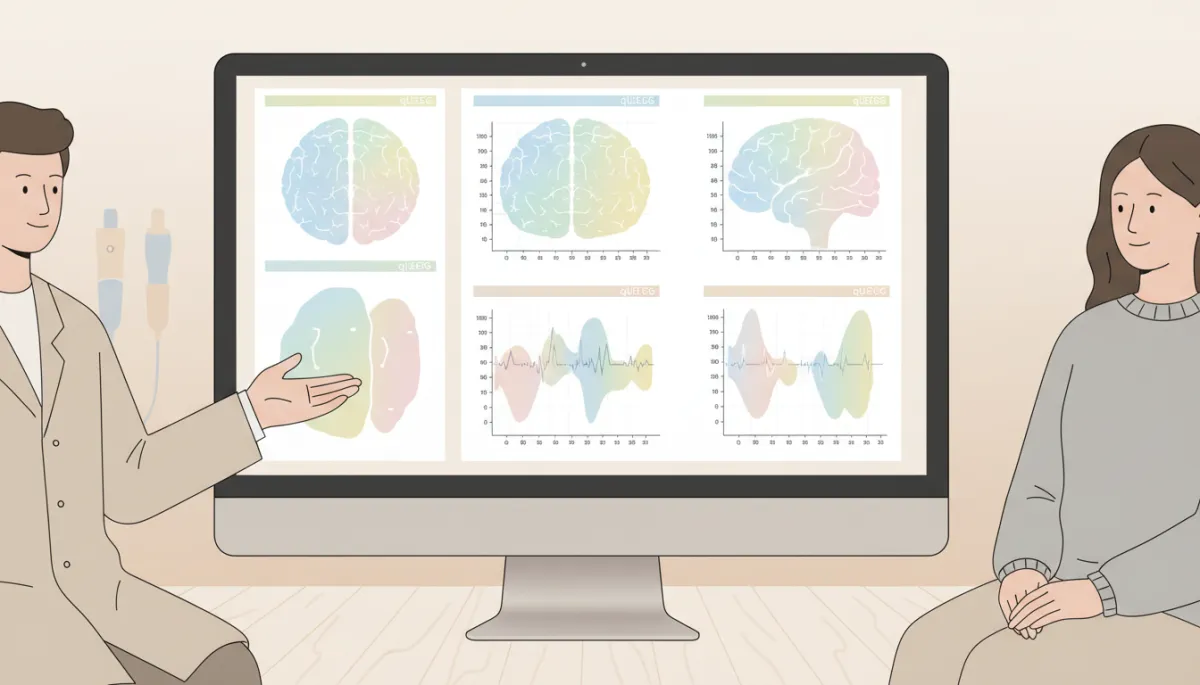
Brain mapping results are reviewed in context, turning complex data into clear explanations.
What Does the Brain Map Actually Show?
A qEEG brain map may provide information about patterns of electrical activity in your brain. These patterns can be explored to better understand how your brain appears to be functioning in different states. For example, the brain map can help explore areas related to:
Focus and concentration – how certain brainwave frequencies behave when you are quietly alert
Relaxation and arousal – how the brain shifts between relaxed and more activated states
Stress and nervous system regulation – patterns that may be associated with how your system responds to and recovers from stress
Sleep-related patterns – aspects of brainwave activity that may relate to drowsiness, rest or difficulty switching off
It is essential to be clear and responsible here. A brain map is information, not a diagnosis. qEEG is not used by Neurotherapy Australia to diagnose medical, psychological or neurological conditions. Instead, the results can provide insight into individual patterns that may be relevant when you are exploring concerns such as focus, stress, sleep or overall wellbeing.
📌 Key Takeaway: A brain map does not tell you “what is wrong” or provide a label. It offers another perspective on how your brain and nervous system may be functioning, which can support informed conversations about your wellbeing.
Why Is Individual Data Useful?
We are all familiar with general advice about stress, sleep, focus and lifestyle. While this information can be helpful, it often assumes that everyone’s brain and nervous system respond in the same way. In reality, everyone is different. Your experiences, environment, history and biology all shape how your system reacts and adapts over time.
Personalised qEEG data can provide another layer of understanding beyond general information. Instead of only asking, “What usually helps people with stress or sleep?”, you can begin to ask, “What do my own brainwave patterns look like, and how might that relate to the way I feel or function day to day?” This can support more tailored strategies and more realistic expectations about change over time.
As a quantitative trader would say, it is the difference between reading a broad market summary and looking closely at the specific behaviour of one portfolio. General trends are useful, but individual data helps you understand your unique profile and make more informed, personalised decisions.
What Happens After the Brain Map?
Session One: Brain & Nervous System Assessment – Data Gathering
At Neurotherapy Australia, brain mapping is part of a two-session Brain & Nervous System Assessment. The first session is focused on gathering information in a calm, structured way. This typically includes:
qEEG brain mapping – recording your brainwave activity using a non-invasive cap or sensors
Wellbeing questionnaires – exploring areas such as mood, sleep, stress and daily functioning from your perspective
Relevant history and information – discussing your concerns, goals, background and any other factors that may be important
This session is designed to be collaborative and respectful. You are encouraged to share what matters most to you, while the clinician focuses on collecting accurate, high-quality data that can be meaningfully reviewed before your second session.
Session Two: Review, Explanation and Next Steps
The second session is where the pieces come together. Here, you sit down with your clinician to review your findings and discuss what they may mean for you. This session usually involves:
A clear explanation of your brain map and key patterns in your qEEG data
Time to ask questions and clarify anything that feels unclear or complex
Discussion of appropriate options based on your goals, preferences and assessment findings
Practical tools, techniques and resources that you can begin to use in everyday life
Rather than leaving you with a technical report, the aim is to translate your brain mapping results into understandable, real-world insights that you can carry forward. You can learn more about the Brain & Nervous System Assessment process on the Neurotherapy Australia website at https://neurotherapyaustralia.com.au/initial-assesement.
Brain Mapping Is About More Than the Technology
The technology behind qEEG brain mapping is sophisticated, but the real value lies in how the information is interpreted and used. Numbers, graphs and maps are only the starting point. They need to be understood in the context of your story, your goals and your nervous system as a whole. This is why Neurotherapy Australia treats brain mapping as one part of a comprehensive brain and nervous system assessment, rather than a stand-alone test.
In many ways, this is similar to the way a financial analyst looks at data. Market prices, charts and indicators are useful, but they only become meaningful when they are connected to a strategy, a risk profile and a clear understanding of the person or organisation involved. In the same way, your brain map becomes most useful when it is integrated into a thoughtful, person-centred conversation about your wellbeing and next steps.
💡 Pro Tip: When you think about brain mapping, focus less on the equipment and more on the questions you would like answered. The assessment is there to support you in exploring those questions with clarity and care.
Brain Mapping on the Gold Coast
If you are looking for brain mapping on the Gold Coast, Neurotherapy Australia provides qEEG brain assessment services as part of its Brain & Nervous System Assessment. The clinic is located at 38/207 Currumburra Rd, Ashmore QLD 4214, Australia, making it accessible for people across the Gold Coast who want to understand their brain and nervous system in more depth.
The focus is on creating a calm, professional and compassionate environment where you can feel comfortable asking questions and exploring your options. Whether you are curious about focus, stress, sleep, performance or general wellbeing, the brain and nervous system assessment Gold Coast service is designed to offer structured, science-informed insights without overwhelming you with jargon or technical detail.
Curious About What Your Brain Map May Show?
If you have ever wondered how your brain is working beneath the surface, a Brain & Nervous System Assessment with qEEG brain mapping can provide a personalised starting point. Rather than guessing, you have the opportunity to look at your own patterns of brainwave activity and discuss what they may mean with a trained clinician in an approachable, supportive setting.
To explore the process in more detail, including current pricing for qEEG assessment, you can visit the Neurotherapy Australia pricing page at https://neurotherapyaustralia.com.au/qeeg-assessment-pricing-page. When you are ready to take the next step, you can learn more about booking your initial brain mapping assessment here: Explore the Brain & Nervous System Assessment.
SEO FAQs About Brain Mapping and qEEG
What happens during a brain map?
During a brain map, small sensors are placed on your scalp to record the electrical activity produced by your brain. You sit comfortably while the qEEG equipment measures your brainwave activity under simple conditions, such as eyes open and eyes closed. The data is then analysed and later reviewed with you as part of a Brain & Nervous System Assessment, so you can understand your individual patterns in a clear, supportive way.
Is brain mapping safe?
Brain mapping using qEEG is considered a safe, non-invasive procedure. The sensors only record electrical activity; they do not send electricity into the brain or change your brainwave patterns. There are no needles, injections or surgery involved, and most people find the process comfortable, though the cap or gel may feel a little unusual at first.
What does a qEEG brain map measure?
A qEEG brain map measures patterns of electrical brainwave activity at the scalp. It records how strong different frequency bands are in various regions and how these patterns may relate to states such as focus, relaxation, arousal, stress and sleep-related activity. The results can provide insight into individual brainwave patterns but are not used by Neurotherapy Australia to diagnose medical, psychological or neurological conditions.
How long does a brain mapping session take?
The time for a brain mapping session can vary, but you can generally expect the first Brain & Nervous System Assessment session, which includes qEEG recording and questionnaires, to take around an hour or more. This allows time for sensor placement, recording your brainwave activity and gathering relevant information in a relaxed, unhurried way. Exact timing can be confirmed with Neurotherapy Australia when you book.
What happens after a brain map?
After your brain map, the recorded data is analysed and integrated with your questionnaires and history. In a separate follow-up session, your clinician reviews the findings with you, explains your results in clear language, answers your questions and discusses appropriate options. You also receive practical tools and resources to support your next steps, based on your individual profile and goals.
Is qEEG a diagnostic test?
No. qEEG is not used by Neurotherapy Australia to diagnose medical, psychological or neurological conditions. Instead, it is used as part of a broader brain and nervous system assessment to explore patterns of brainwave activity and provide additional information that may be relevant when considering wellbeing, stress, focus, sleep or nervous system regulation.