Calm Your Mind: Nervous System Relief Tips
Nervous System Regulation, Stress Relief, Brain Health, Gold Coast
Stressed? Try This: Give Your Nervous System a Chance to Settle
Racing thoughts. Tight shoulders. That sense that your brain is still “on” even though you’re finally home on the Gold Coast and the day is supposed to be over. Your breathing feels a little faster. It’s hard to focus on one thing at a time. Part of you wants to rest, and another part feels like you need to keep going.
Stress can feel loud and obvious, like a surge of urgency in your body. It can also feel quiet and persistent, like you haven’t been able to properly switch off all day. In both cases, the nervous system is doing something very normal: responding to demands. Sometimes the most useful first step is not doing more, but creating a brief pause. A small window where your body has a chance to settle, even just a little.
What Happens When You Feel Stressed?
Stress is not a character flaw. It’s a normal physiological response to things your brain decides are important. That might be a deadline, a family responsibility, traffic on the M1, or a difficult conversation you know is coming. Your brain constantly scans for what needs attention and prepares your body to respond.
When your brain registers a demand, your stress response system — including areas like the amygdala, prefrontal cortex and brainstem — sends signals through your autonomic nervous system. This is the part of your nervous system that helps regulate automatic functions like heart rate, breathing and digestion. As this system activates, you might notice:
Faster or shallower breathing, especially in the upper chest
Increased or more noticeable heart rate or heartbeat sensations
Tightness in the shoulders, jaw or back as muscles prepare for action
Greater alertness and narrowed focus on whatever feels urgent or important
Racing or repetitive thoughts that keep circling around the same issue
These changes are part of a protective pattern designed to help you respond to life’s demands. On their own, they do not automatically mean there is a health problem. They are signs that your nervous system is activated and doing its job: mobilising you to deal with what’s in front of you.
Your Nervous System Doesn't Need You to Eliminate Stress
In conversations about nervous system regulation , it can sometimes sound like the goal is to stay calm all the time. That isn’t realistic — and it isn’t necessary. Daily life on the Gold Coast includes busy workdays, family schedules, financial decisions, community commitments and unexpected changes. Your nervous system needs the ability to become more alert and activated when life asks for more from you.
What matters most is not avoiding stress altogether, but supporting flexibility — the capacity to move between activation and recovery:
Activation when needed: Your system can gear up when you need to focus, respond or take action.
Recovery when possible: When the demand has passed, your system has chances to settle, restore and reset.
Problems can arise when life feels like all activation and almost no recovery. Emails late at night, constant notifications, back-to-back commitments and limited sleep can make it harder for your nervous system to shift out of “doing” mode. Creating even very small opportunities to settle — a few minutes at a time — can support this flexibility over the course of the day.
Try a Simple Breathing Pause
One accessible way to create a recovery opportunity is a breathing pause . This is not about perfect technique or forcing relaxation. It’s about giving your body a brief window where it can shift away from constant stimulation and towards settling — even slightly.
Stop for a moment. If it’s safe to do so, pause what you’re doing. You might sit on a chair, stand on your balcony, or rest your hands on the steering wheel while the car is parked.
Soften your body if comfortable. Gently relax your shoulders away from your ears. Unclench your jaw. Let your hands rest. There’s no need to force anything — just invite a little softness where you can.
Breathe through your nose if that feels okay. Take a natural, gentle inhale. It doesn’t need to be very deep. Aim for comfortable rather than dramatic.
Allow a slow, easy exhale. Let your breath out in a way that feels smooth and unhurried. You might notice that a slightly longer exhale feels settling, but there is no need to count or control every second.
Continue for a few minutes. Repeat this gentle pattern of breathing in and breathing out. If your mind wanders, that’s normal. Each time you notice, simply return your attention to the next easy exhale.
Notice your body, without chasing a result. You might feel exactly the same. You might notice small shifts — slightly less tension, a softer jaw, a tiny bit more space in your chest. All of these responses are valid. The practice is the pause itself, not a specific outcome.
If focusing on your breathing makes you feel uncomfortable, light-headed or more anxious, it’s okay to stop and return to your usual breathing. Another form of stress relief — such as a short walk or gentle stretching — may be more suitable for you right now.
Why Might Slower Breathing Help?
To understand why this simple breathing pause can be helpful for nervous system regulation , it helps to look briefly at the autonomic nervous system . This system has two main branches working together:
The sympathetic branch , which supports activation, mobilisation and energy when you need to respond or perform.
The parasympathetic branch , which supports recovery, digestion and restoration when there is room to settle.
Your breathing sits at a unique crossroads between automatic and voluntary control. Most of the time you don’t think about breathing at all, yet you can also consciously change your breathing pattern. This makes breathing a practical way to gently influence your level of physiological arousal and support nervous system regulation techniques in everyday life.
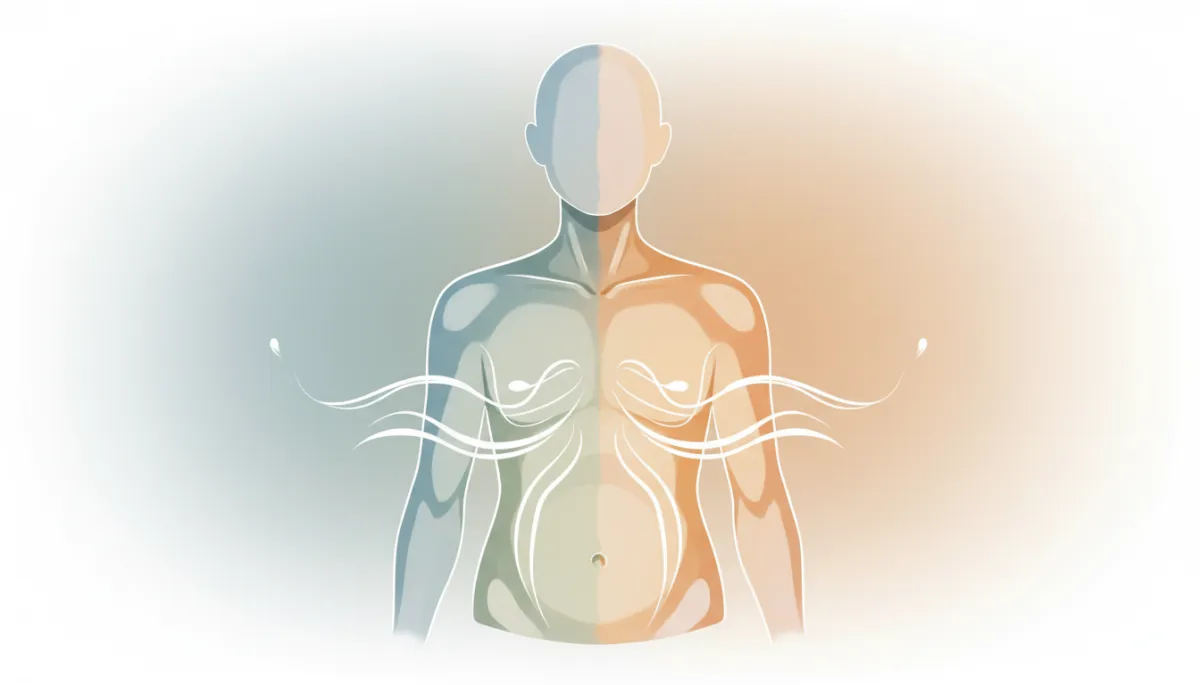
Slower, comfortable breathing can offer a gentle cue toward recovery for some nervous systems.
When you breathe quickly and shallowly, your body may stay in a more activated state. When you shift to slower, more comfortable breathing , a few things may happen:
Your heart and lungs receive signals that may support a calmer physiological state over time.
Your attention has a simple, present-moment focus — the in-breath and out-breath — which can be grounding when thoughts feel scattered.
You are actively creating a pause between one task and the next, which can reduce the sense of constant pressure.
For some people, this combination of physiological and attentional shifts can support stress relief and a greater sense of steadiness. It is important to note that breathing does not directly “switch off” the stress response, cure anxiety or guarantee relaxation. Rather, it offers one gentle way to invite your nervous system to explore a slightly different state, even for a short time.
Don't Turn Relaxation Into Another Task
Many people on a stress management journey accidentally turn calming practices into another performance goal. You might find yourself thinking:
“Am I breathing correctly?”
“Why am I still stressed?”
“Why isn’t this working yet?”
When this happens, the nervous system can interpret the exercise itself as another demand. Instead of feeling supported, you may feel like you are failing at relaxation — which is the opposite of what you need in that moment.
📌 Key Takeaway: The goal of a breathing pause is not to achieve perfect calm. It is simply to create a small opportunity to pause, notice and offer your nervous system a chance to shift — even slightly — towards recovery.
You do not need a dramatic change in how you feel for the pause to be worthwhile. Even if you still feel activated afterwards, you have practised an important skill: stepping out of automatic “go mode” for a moment and checking in with your body. Over time, these small, compassionate pauses can add up.
Other Ways to Create Recovery Opportunities
Breathing is just one way to support nervous system regulation . Many everyday choices can also create small pockets of recovery in a busy Gold Coast day. Different stress relief techniques work differently for different people, and that’s okay. You might like to experiment with:
Taking a short walk: A few minutes of gentle movement — around the block, along the beach, or even through your garden — can give your brain and body a break from prolonged sitting and screen time.
Stepping away from screens: Turning away from emails, news and notifications for even five minutes can reduce sensory load and support nervous system and stress recovery.
Spending time outdoors: Natural light, fresh air and open space can provide a different kind of input for the brain, which some people find settling and restorative for brain health and mood.
Reducing unnecessary stimulation: Lowering background noise, dimming bright lights in the evening or silencing non-essential notifications can gently lower the overall load on your nervous system.
Stretching or gentle movement: Soft neck, shoulder or back stretches can help you notice and release pockets of tension that build up through the day.
Evening wind-down routines: Simple, repeatable patterns — like reading, light stretching or a warm shower — can signal to your nervous system that the day is winding down and support sleep-related recovery processes.
Short breaks during demanding periods: Even two or three minutes between meetings or tasks can help prevent the feeling of one long, unbroken stress response.
💡 Pro Tip: Instead of searching for one perfect nervous system regulation technique , think about building a small collection of options you can use at different times of day and in different environments.
When Stress Keeps Showing Up
Occasional stress is part of being human. But when stress feels persistent or overwhelming, it can start to affect many areas of life. Ongoing activation of the stress response may be associated with experiences such as:
Difficulty falling or staying asleep, or waking feeling unrefreshed
Trouble concentrating or holding attention on one task at a time
Lower energy or a sense of being constantly “wired and tired” at the same time
Changes in mood, such as feeling more irritable, flat or overwhelmed than usual
Increased physical tension, headaches or body discomfort without a clear physical cause identified yet
These experiences can have many different contributing factors, including medical, psychological, environmental and lifestyle influences. They should not automatically be attributed to stress alone. If symptoms are persistent, severe or are affecting your daily life, it is important to speak with an appropriately qualified healthcare professional, such as your GP or psychologist. Breathing practices and other stress relief techniques are not a replacement for individual medical or psychological care.
Understanding Your Individual Nervous System Patterns
One of the most important things to remember is that there is no single “correct” nervous system response. Two people can go through the same demanding situation — a tight deadline, a family challenge, a period of poor sleep — and their brains and bodies may react quite differently. Factors like genetics, previous experiences, physical health, sleep quality, environment and current life load all shape how your nervous system responds and recovers.
At Neurotherapy Australia on the Gold Coast, our work is grounded in helping people better understand their individual brain and nervous system patterns . Rather than assuming that one strategy will work the same way for everyone, we focus on assessment, education and practical, personalised approaches to nervous system regulation and brain health support.
Depending on your needs and goals, a Brain & Nervous System Assessment may include tools such as:
qEEG brain mapping: A method of recording and analysing brainwave activity to provide information about patterns of brain function. This does not diagnose mental health or neurological conditions but can add useful context to your overall picture.
Heart rate variability (HRV) measurement: A way of looking at subtle variations in the time between heartbeats, which can offer insights into how your autonomic nervous system is responding to demands and recovery opportunities over time.
Relevant wellbeing questionnaires: Structured questionnaires can help capture your experiences of stress, sleep, mood, focus and daily functioning in a systematic way.
Nervous system education: Clear, practical explanations of how your brain and body respond to stress, and how nervous system regulation techniques can be woven into real life in a way that feels sustainable and realistic.
Personalised brain training and nervous system training: Approaches designed to support more flexible patterns of activation and recovery, tailored to your individual assessment results and goals. Again, these are not diagnostic tools, but ways of working with your nervous system to support wellbeing.
📌 Key Takeaway: Understanding your own patterns can make it easier to choose which strategies are most likely to support your nervous system regulation Gold Coast lifestyle — and how to apply them in a way that fits your real world, not an idealised version of it.
The Brain & Nervous System Assessment at Neurotherapy Australia, located at 38/207 Currumburra Road, Ashmore QLD 4214, Gold Coast, Australia , is designed to provide personalised information and guidance. It does not replace medical or psychological assessment, and it does not diagnose stress, anxiety or neurological conditions. Instead, it offers an additional layer of insight to help you understand how your brain and nervous system are responding — and how you might support them in practical ways.
Sometimes, the First Step Is Simply to Pause
You don’t always need to do more to manage stress. In fact, constantly adding new tasks, rules and expectations can sometimes keep your nervous system in a state of ongoing activation. Instead, you might start with something smaller and kinder: a brief pause to breathe and notice.
A few slow, comfortable breaths. A short walk away from your screen. A moment on your balcony, looking at the sky. These may sound simple, but they are all ways of telling your nervous system: “You have permission to shift, even just a little, towards recovery.” Over time, these small moments can support a more flexible relationship with stress — one where activation and recovery both have a place.
And if stress continues to shape how you sleep, concentrate, recover or feel throughout the day, gaining a clearer understanding of your individual brain and nervous system patterns can be a valuable next step. You don’t have to figure it all out on your own.
Explore Your Brain & Nervous System on the Gold Coast
If you’d like to understand your own patterns more clearly, you can learn more about Neurotherapy Australia’s Brain & Nervous System Assessment and how it may support your stress management and wellbeing goals. Our clinic at 38/207 Currumburra Road, Ashmore QLD 4214, Gold Coast, Australia offers a calm, professional environment for exploring how your brain and nervous system are working together in everyday life.
When you’re ready, you can:
Learn more about the Brain & Nervous System Assessment process and what to expect.
Contact Neurotherapy Australia with questions about how assessment and training may fit with your existing healthcare supports.
Book an assessment to gain personalised insights into your brain and nervous system and explore practical next steps.
You don’t need to wait until stress becomes unmanageable. Sometimes, the most meaningful change begins with a single, gentle decision: to pause, to notice, and to understand your nervous system a little more clearly.
Ever wonder what's going on inside your brain? Book a Brain and Nervous System Assessment today! Click here to find out more →