Train Your Brain: Neuroplasticity & Brain Health
Brain Training, Neuroplasticity, Brain Health, Gold Coast
You Can Train Your Brain: Neuroplasticity, Practice and Thoughtful Brain Training
Many of us grow up with the quiet assumption that our brain is largely fixed: you are either “good with focus”, “bad with names” or “prone to stress”, and that’s simply how it is. Yet modern neuroscience tells a more hopeful – and more nuanced – story. The brain is not a static organ. It is responsive, adaptable and continually reshaping itself in response to what we do, feel, practise and repeat over time. This capacity for change is known as neuroplasticity, and it underpins the idea that you can, in meaningful ways, train your brain.
Your Brain Can Adapt
Neuroplasticity is the brain’s ability to adapt its structure, function and patterns of activity in response to experience. Rather than behaving like a fixed circuit board, the brain is more like a living network: it can strengthen some pathways, quieten others and build new patterns when the conditions are right. This is not about instant rewiring or overnight transformation. It is about gradual, experience-driven adjustment that accumulates over time.
When you learn a language, practise a new movement, develop a meditation habit or repeatedly train your attention, your brain is not just storing information – it is reorganising how different regions and networks work together. Certain connections may become more efficient, particular responses may become more automatic and some patterns may become easier to access. This is part of why a skill that once felt effortful can later feel more natural or fluent. The underlying brain systems have adapted to support that pattern more efficiently.
Importantly, neuroplasticity has limits and is influenced by many factors: the type of training, the level of challenge, your overall health, your nervous-system state and how consistently you practise. The capacity to adapt is real, but it is not limitless or identical for every person. A responsible approach to brain training acknowledges both the brain’s remarkable adaptability and its very real constraints.
What Is Neuroplasticity?
At its core, neuroplasticity refers to the brain’s ability to change in response to what you repeatedly experience and do. This includes changes in:
Structure – such as the density of connections in certain regions or the size of networks involved in particular skills.
Function – how strongly or efficiently areas of the brain activate during specific tasks or states.
Connectivity – how different regions communicate and coordinate with each other over time.
You can see neuroplasticity in action in everyday life. When you first learn to drive, every movement – checking mirrors, changing gears, scanning the road – demands conscious effort. After months or years of practice, many of these actions become more automatic. The underlying brain networks involved in attention, movement and decision-making have become more coordinated and efficient for that task. The same principle applies when you learn a musical instrument, practise a new sport, study a complex subject or build a mindfulness practice. The brain gradually refines its patterns to support what you repeatedly do.
Neuroplasticity also operates in less obvious ways. Repeatedly practising shifting your attention back to a task can help strengthen the networks that support sustained focus. Regularly engaging in calming practices can help your nervous system become more familiar with settling after stress. Over time, these repeated experiences can influence how easily your brain and body access certain states – not because you have “fixed” yourself, but because you have trained particular patterns through experience and repetition.
Why Repetition Matters
One of the most important principles in both learning and brain training is repetition. Each time you practise a skill, engage in a pattern of thinking or respond to a situation in a particular way, your brain has another opportunity to strengthen the pathways involved in that response. Over time, repeated experiences can make certain patterns more likely to occur again – whether they are helpful or unhelpful.
This does not mean that repetition automatically leads to unlimited improvement, or that any repeated activity will transform your brain. The quality of practice matters. Repeating a skill with focused attention, clear feedback and appropriate challenge tends to be more effective than going through the motions without engagement. The relevance and context of practice also matter: training that closely resembles the real situations you care about is more likely to transfer into everyday life than training that feels disconnected from your goals.
Repetition also interacts with rest. Just as muscles need recovery for physical training to be effective, the brain benefits from sleep, downtime and variation. Many of the processes that support learning and consolidation occur when you are not actively practising. In other words, meaningful brain change is more like a training program than a single workout: it involves repeated, purposeful practice over time, supported by recovery and consistency.
What Does Brain Training Actually Mean?
“Brain training” is a broad term. It does not refer to one single method or app. Instead, it describes a range of approaches that aim to engage and shape brain function through structured practice. Some common forms include:
Cognitive training – targeted exercises designed to challenge areas such as attention, working memory, processing speed or problem-solving, often delivered through computer-based tasks or structured activities.
Skill learning – practising a new language, instrument, sport or movement pattern, which naturally engages and refines multiple brain networks over time.
Attention training – exercises that involve deliberately directing and redirecting attention, such as mindfulness practices, focused-attention tasks or structured concentration exercises.
Neurofeedback or biofeedback – approaches that provide real-time feedback about aspects of brain activity (such as EEG patterns) or physiological signals (such as heart rate variability), allowing people to practise shifting their state with guidance.
Structured brain training programs – comprehensive programs that combine assessment, targeted exercises, education and coaching to support specific goals, such as focus, stress management or cognitive efficiency.
Each of these approaches has different goals and levels of evidence. Some forms of cognitive training may improve performance on the specific tasks that are practised, while other approaches show more general benefits in everyday functioning for certain individuals. It is important not to assume that every commercial brain training program will produce the same results, or that one type of training can address every concern. A thoughtful, evidence-aware approach starts with understanding what you are trying to change, how that relates to brain and nervous-system function, and which methods are most appropriate for your situation.
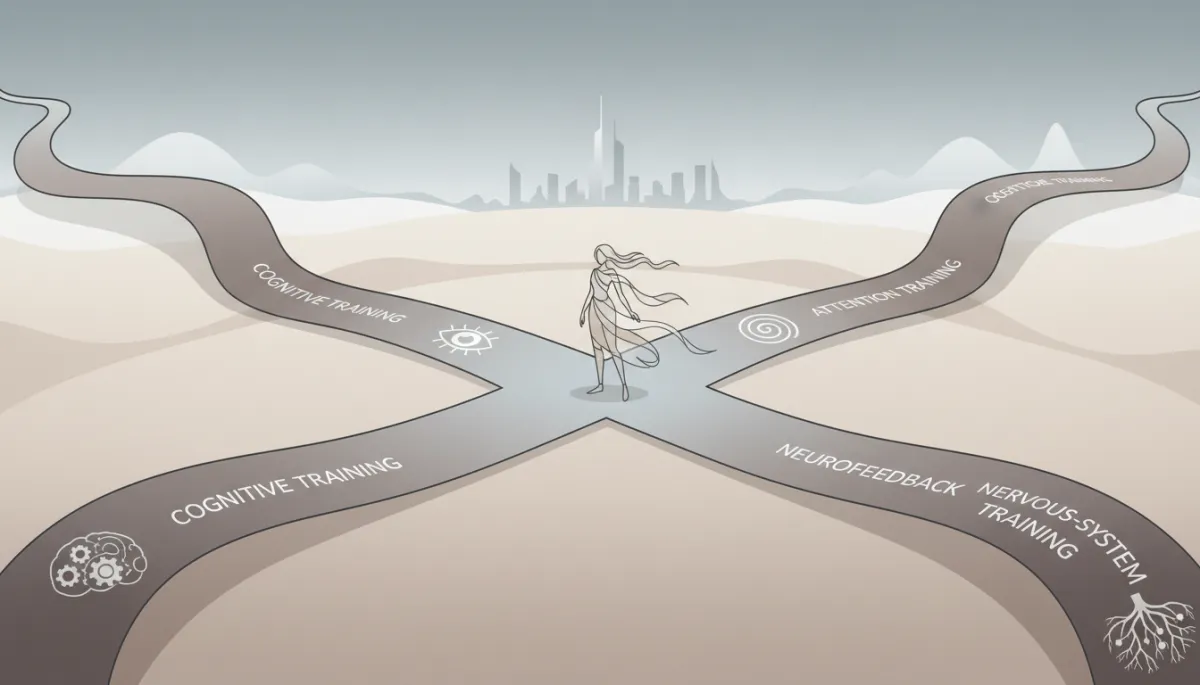
Brain training is an umbrella term; different methods serve different goals and individuals.
The Goal Isn’t to Make Your Brain Work Harder
It can be tempting to equate effective brain training with pushing yourself to the limit – more tasks, more stimulation, more hours. In reality, quality brain training programs are not about making your brain work as hard as possible. They are about creating the right conditions for meaningful adaptation. This often involves:
Appropriate challenge – tasks that are demanding enough to engage your brain, but not so difficult that they become overwhelming or discouraging.
Repetition with variation – practising key skills repeatedly, while gradually adjusting difficulty or context to keep learning active and relevant.
Feedback – receiving clear information about how you are performing, whether through scores, coaching or physiological feedback, so you can adjust in real time.
Consistency – engaging with training regularly enough for your brain to recognise the pattern as something worth adapting to.
Individualisation – tailoring the type, intensity and focus of training to your goals, abilities and nervous-system state, rather than applying a one-size-fits-all protocol.
Recovery – allowing space for rest, integration and everyday life, recognising that sustainable change depends on balance, not constant strain.
More stimulation is not automatically better. In some cases, constantly pushing for more can increase stress, reduce focus and make it harder for learning to consolidate. Effective brain training is purposeful. It respects the realities of how the brain learns, adapts and tires. It aims to support clearer, more efficient patterns – not to keep your system in a state of permanent overdrive.
Brain Training and the Nervous System
Your brain does not operate in isolation from the rest of your body. It is part of a wider nervous system that includes your spinal cord, peripheral nerves and the autonomic systems that shape heart rate, breathing, digestion and more. How you engage with brain training – and how well you learn – is influenced by this broader system, particularly your levels of attention, arousal, stress and recovery.
When your stress levels are very high, your system may prioritise short‑term survival responses over reflective learning. You might feel restless, hyper‑alert or easily distracted. In this state, complex cognitive tasks can feel harder, and it may be more challenging to absorb new information or practise calm focus. On the other hand, when arousal is too low – for example, when you are exhausted or disengaged – it can also be difficult to stay present with training. There is often a “sweet spot” of alert, grounded attention where learning and adaptation are more likely to occur.
This is why thoughtful brain training Gold Coast providers increasingly consider nervous system regulation alongside cognitive performance. Practices that support balanced arousal – such as breathing exercises, movement, sleep hygiene and guided relaxation – can complement cognitive and attention training. Brain training on its own does not “fix” the nervous system, but it can be part of a broader approach that respects the interaction between attention, stress, recovery, learning and adaptation.
Can Brain Training Help Everyone in the Same Way?
Neuroplasticity is a universal property of the brain, but that does not mean every person responds to training in the same way. Two people can complete the same program with very different experiences and outcomes. This variation is influenced by many factors, including:
Baseline abilities – your starting point in areas such as attention, memory, processing and self-regulation.
Sleep and recovery – the extent to which your brain has the opportunity to consolidate learning between training sessions.
Stress and load – ongoing stress, overwhelm or health issues can shape how much capacity you have for focused training at any given time.
Motivation and engagement – feeling connected to the purpose of training and being genuinely engaged with the process supports better outcomes than training that feels purely obligatory.
Consistency – irregular or fragmented practice typically leads to different results than steady, ongoing engagement over weeks or months.
Training type and fit – approaches that are well matched to your goals, preferences and nervous-system state are more likely to be helpful than those that are not aligned with your needs.
Because of these differences, responsible practitioners avoid promising guaranteed outcomes. Instead, they focus on providing informed guidance, tracking progress and helping you understand how your own brain and nervous system are responding. For some people, the most meaningful changes may be in sustained attention. For others, it may be in how quickly they recover from stress, how efficiently they complete tasks or how confident they feel managing their cognitive load. The key is individualisation – and that begins with understanding your unique patterns.
Understanding Your Brain Before You Train It
Before committing to any structured brain training programs, it can be valuable to understand how your brain and nervous system are currently functioning. Rather than guessing which exercises might help, an assessment‑led approach aims to map existing patterns, clarify goals and identify which types of training may be appropriate. This is the philosophy behind Neurotherapy Australia’s work with adults seeking brain training Gold Coast options for focus, stress management and cognitive wellbeing.
At Neurotherapy Australia, the Brain & Nervous System Assessment is designed to help you explore your individual patterns in a structured, evidence‑aware way. Depending on your situation, this may include:
qEEG brain mapping – recording electrical activity from the scalp to explore patterns of brainwave activity across different regions. qEEG does not independently diagnose medical, psychological or neurological conditions, but it can provide useful information about how your brain is functioning during rest and tasks.
Heart rate variability (HRV) measurement – examining moment‑to‑moment variation in heart rate as one window into autonomic nervous-system regulation, including how your system responds to and recovers from stress. HRV is not a stand‑alone diagnostic tool, but it can contribute to a broader picture of nervous-system function.
Relevant wellbeing questionnaires – structured self‑report measures that capture your experiences of focus, mood, stress, sleep and daily functioning, helping to align training with what actually matters in your life.
Nervous-system education – clear, accessible explanations of how your brain and nervous system work together, and how factors such as stress, recovery and attention can influence your experience of daily life and training.
Personalised brain training and nervous-system training recommendations – where appropriate, guidance on structured exercises or programs that may support your goals, informed by your assessment results and preferences.
The aim of this assessment is not to label or diagnose. Instead, it is to provide a more detailed, personalised understanding of how your brain and nervous system are functioning right now, and to help you make informed decisions about personalised brain training and nervous-system training. For many people on the Gold Coast, this kind of clarity can be a meaningful first step toward more intentional, realistic and compassionate brain health choices.
Training Is a Process, Not a Quick Fix
In a culture that often promises rapid transformation, it is worth emphasising that meaningful brain change usually unfolds gradually. Whether you are working on focus, stress resilience, cognitive efficiency or everyday mental performance, train your brain is less a slogan and more a description of a process: repeated, purposeful practice supported by understanding, feedback and time. There are no shortcuts that bypass the fundamental principles of neuroplasticity.
This process‑based view can actually be freeing. It shifts the focus from finding the “perfect” app or exercise to building sustainable habits and environments that support your brain and nervous system. It invites realistic expectations: some days will feel easier than others; progress may be uneven; and external factors such as sleep, workload and health will influence your experience. Over time, however, consistent practice can help your brain become more familiar with the patterns you are cultivating – whether that is sustained attention, more efficient problem‑solving or a calmer response to everyday stressors.
Your brain is not fixed. But it is also not a blank slate that can be reshaped at will. The reality sits in between: a responsive, adaptive organ that can change within certain bounds when given the right combination of practice, repetition, context, support and time. Understanding this helps you approach neuroplasticity and brain health with both optimism and grounded realism.
Exploring Your Own Brain and Nervous System on the Gold Coast
If you are curious about how these ideas apply to you personally, a structured brain and nervous system assessment can be a thoughtful next step. At Neurotherapy Australia’s clinic at 38/207 Currumburra Road, Ashmore QLD 4214, Gold Coast, Australia, adults interested in brain training, neuroplasticity, focus, stress management and cognitive wellbeing can explore their individual patterns in a calm, professional setting.
The Brain & Nervous System Assessment does not promise instant change or guaranteed outcomes. Instead, it offers clarity: a more detailed understanding of how your brain and nervous system are currently functioning and how that might relate to your everyday experience of focus, energy, stress and mental performance. From there, you can consider whether personalised brain training, nervous-system training, lifestyle adjustments or other supports might be appropriate for you, in collaboration with qualified professionals and your wider healthcare team as needed.
Your brain is capable of adapting. With thoughtful practice, supportive environments and realistic expectations, you can work with that capacity in a way that respects both the science and your lived experience. You do not need to chase miracle promises. Instead, you can choose a grounded path: understanding your patterns, engaging in well‑designed training where appropriate and allowing time for meaningful change to emerge.
A Considered Invitation to Train Your Brain
Neuroplasticity reminds us that our brains are not frozen in place. They respond to what we practise, pay attention to and repeatedly experience. Meaningful change is rarely instant, but it is possible – built through practice, repetition, understanding and time. If you are on the Gold Coast and would like to explore your own brain and nervous-system patterns in a structured, evidence‑aware way, Neurotherapy Australia offers a calm, professional space to begin that exploration.
You can learn more about the Brain & Nervous System Assessment, ask questions about brain mapping Gold Coast options and discuss whether a personalised approach to brain training and nervous system regulation feels appropriate for you. There is no rush and no pressure – simply an invitation to understand your brain a little more clearly and to consider what kind of training, if any, aligns with your goals and values.
To explore the Brain & Nervous System Assessment or to enquire about personalised brain training on the Gold Coast, you are welcome to contact Neurotherapy Australia and book an assessment at: 38/207 Currumburra Road, Ashmore QLD 4214, Gold Coast, Australia. Your brain is not fixed – and you do not have to navigate its possibilities alone.
Ever wonder what's going on inside your brain? Book a Brain and Nervous System Assessment today! Click here to find out more →