Understanding Brain Mapping & Its Benefits
Neurotherapy, Brain Mapping, Brain Health Assessment, Neurotherapy Gold Coast
What Can Brain Mapping Help You Understand About Your Brain?
Have you ever wondered why you can feel focused one day and mentally scattered the next? Why sleep, stress, or even a busy week can change how clearly you think or how calm you feel? Brain function is complex, and it can vary not only between people, but also from moment to moment in the same person. Brain mapping, particularly qEEG brain mapping, can provide another layer of information about the patterns of brain activity that sit underneath your everyday experience.
Your Brain Has Patterns, Not Simple “Good” or “Bad” Activity
Your brain is never still. Even when you are relaxing on the couch or drifting off to sleep, networks of brain cells are constantly communicating. This activity naturally shifts across the day as you move between tasks, conversations, rest and recovery. A qEEG assessment (quantitative electroencephalography) does not freeze your brain in time; instead, it can provide a snapshot of the patterns of activity present during particular recording conditions, such as eyes open or eyes closed resting states, or simple cognitive tasks.
These patterns may relate to familiar experiences such as:
Attention: how easily you can sustain focus or shift between tasks
Relaxation: your capacity to unwind, slow down and feel settled
Mental effort: how “hard” your brain seems to work during thinking tasks
Alertness: feeling switched on, drowsy, or somewhere in between
Recovery: how your brain may settle after stress or effortful activity
Importantly, a brain map does not label your brain as “good” or “bad.” Different brain activity patterns can be useful in different situations. For example, a more relaxed pattern might be helpful for falling asleep, while a more alert pattern may be helpful when you are solving a problem. Brain mapping can help explore which patterns tend to show up for you in particular conditions, without judging them.
Understanding Attention and Mental Focus
Many people first hear about qEEG brain mapping when they are exploring questions about attention, concentration or mental performance. They might ask, “Can a brain map tell me if I have ADHD?” It is important to be clear: qEEG is not a diagnostic test for ADHD or any other condition. Instead, it may provide information about brain activity patterns that can be discussed alongside your history, goals and other assessments.
During a brain health assessment, certain patterns may be associated with states such as:
finding it easier to stay on task for longer periods
feeling mentally restless or easily distracted
needing extra effort to organise thoughts and actions
feeling mentally fatigued after concentration
In a qEEG assessment, this information can help open a more personalised conversation about how your brain appears to engage during rest or simple tasks. For example, someone who describes “zoning out” when reading may see patterns that, when interpreted carefully and in context, are consistent with reduced sustained attention in certain regions. Another person who reports feeling “wired but tired” might show patterns that may relate to heightened alertness even when they are trying to relax.
💡 Thoughtful Note: qEEG brain mapping can provide insight into how your brain may be engaging with tasks, but it does not confirm or rule out specific diagnoses. Any concerns about attention or learning still warrant appropriate medical or psychological care where relevant.
Rather than reducing attention to a single score, brain mapping may help you and your clinician discuss how different regions of your brain appear to participate in focus, how easily your brain shifts between relaxed and active states, and where there may be opportunities for tailored training or support.
Looking at Stress, Recovery and the Nervous System
Stress does not only live in your thoughts; it can influence your entire brain and nervous system. When you are under ongoing pressure, sleeping poorly, or constantly “on alert,” your brain may spend more time in patterns associated with heightened vigilance or reduced ability to switch off. Over time, this may affect how refreshed you feel, how easily you recover after challenges, and how resilient you feel during daily life.
In a brain and nervous system assessment, qEEG brain mapping may offer one lens on how your brain appears to be functioning in the context of stress and recovery. For example, during a resting-state recording, some people may show patterns that are often seen when the brain is more activated or “on guard,” even when they are trying to relax. Others may show patterns that may relate to feeling flat, slowed or fatigued. These are not diagnoses; they are pieces of information that can help guide discussion.
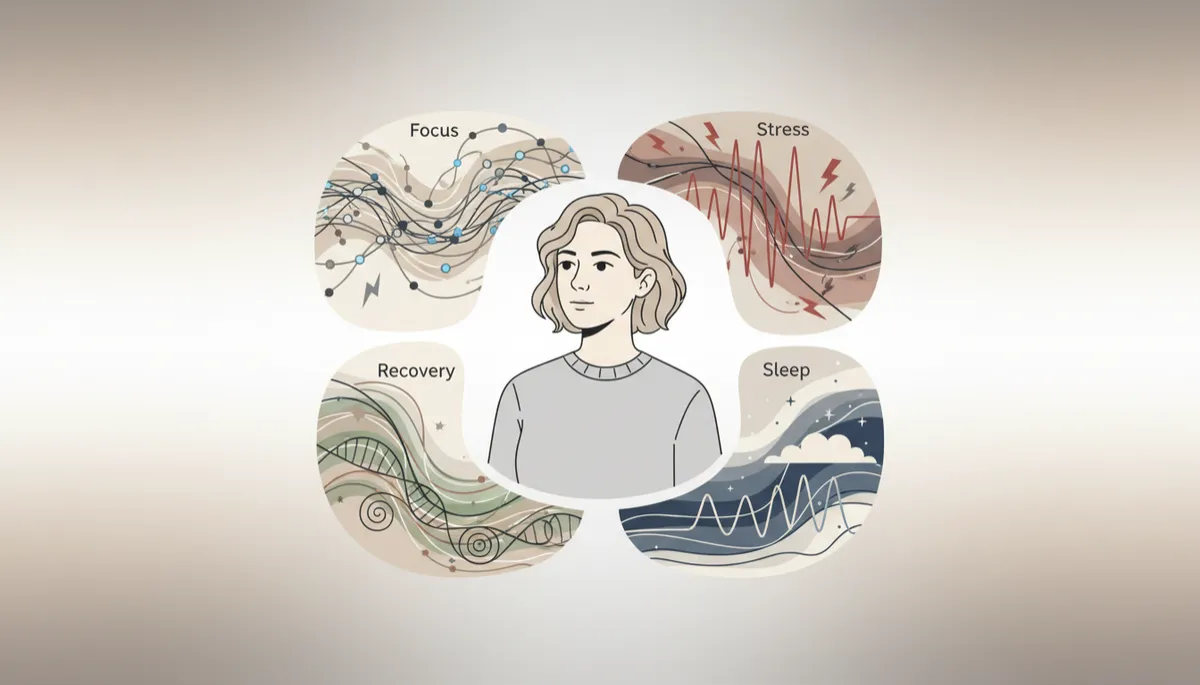
Brain mapping may highlight how focus, stress, recovery and sleep interact as part of one system.
At Neurotherapy Australia, brain mapping Gold Coast services may also be considered alongside measures such as heart rate variability (HRV) and wellbeing questionnaires. HRV provides information about how your autonomic nervous system is regulating, while questionnaires capture your lived experience of stress, mood, sleep and daily functioning. When these pieces are brought together, they can help build a more complete picture of how your brain and nervous system may be responding to life’s demands.
📌 Key Takeaway: qEEG brain mapping cannot determine the exact cause of your stress or diagnose a stress disorder. It can, however, contribute to understanding how your brain appears to be operating in the broader context of your health, history and environment.
Why Context Matters in Brain Mapping
A brain map should never be interpreted in isolation. Just as a single blood pressure reading does not describe your entire cardiovascular health, a single qEEG recording does not capture everything about your brain or nervous system. Context is essential.
When reviewing brain activity patterns, clinicians may consider factors such as:
Sleep: Did you sleep well the night before? Are you experiencing ongoing insomnia or irregular sleep?
Stress levels: Have there been recent life events or ongoing pressures that may influence your nervous system state?
Physical activity: How active are you day to day, and how does movement affect your energy and mood?
Emotional state: What feelings or emotional patterns have been present recently?
Medications and substances: Are there prescribed medications, caffeine, alcohol or other substances that may influence brain activity?
Lifestyle: Nutrition, work patterns, screen time and daily routines all shape how your brain functions over time.
Individual history: Past experiences, learning history, injuries or health conditions form part of your unique story.
Because brain activity is dynamic, two people with similar qEEG findings may feel very different in daily life. Conversely, two people with similar concerns may show different patterns on their maps. This is why understanding brain function through qEEG is always a collaborative process that blends data with conversation, clinical reasoning and, when appropriate, input from other health professionals.
What a Brain Map Cannot Tell You
With growing interest in neuroscience, it can be tempting to hope that a single test will explain everything. Being clear about the limits of qEEG is an important part of responsible practice. A brain map is one source of information, not a verdict on your health, personality or future.
qEEG brain mapping is not a standalone diagnostic test.
It does not diagnose ADHD, depression, anxiety, autism, trauma or neurological disease.
It cannot predict someone’s future health, success or potential.
It should not be read as a simple “normal versus abnormal brain” score.
Instead, qEEG can provide insight into how your brain appears to be functioning under specific conditions, and how that may relate to your experience of focus, stress, sleep, recovery or mental performance. If there are concerns about mental health, neurological conditions or significant changes in functioning, appropriate medical or psychological assessment remains essential. Brain mapping does not replace those forms of care.
⚠️ Important: If you are experiencing distress, sudden changes in thinking, mood or behaviour, or worrying physical symptoms, please seek advice from your GP, psychologist or other qualified health professional. qEEG is not designed to assess emergencies or provide crisis support.
From Information to Personalised Support
When used thoughtfully, brain mapping can become one component of a broader, personalised approach to supporting your brain and nervous system. At Neurotherapy Australia on the Gold Coast, a brain and nervous system assessment may include:
qEEG brain mapping: to explore patterns of electrical activity in different regions of the brain under structured conditions.
HRV measurement: to provide information about autonomic nervous system regulation and recovery capacity.
Relevant wellbeing questionnaires: to capture your experience of focus, mood, sleep, stress and daily functioning in your own words.
Personalised discussion: to connect the data with your goals, history and what matters most to you right now.
Education around brain and nervous-system function: to help you understand how your brain may be working and how different forms of training or support might fit.
From there, the aim is not to “fix” a single number on a report, but to use the information to help guide practical, personalised strategies. This may include neurofeedback training, nervous-system regulation strategies, or other supports discussed with you. While no approach can guarantee outcomes, having a clearer starting point may help make decisions more targeted and collaborative.
Who Might Be Interested in Brain Mapping?
Brain mapping is not something everyone needs. However, some people are particularly drawn to the idea of seeing how their brain appears to be functioning, especially when they value a personalised, data-informed approach. People who may be curious about qEEG brain mapping or neurotherapy Gold Coast services often include those who want a more tailored starting point for exploring:
Focus and attention: understanding why concentration feels easier in some situations than others, and how their brain may be engaging during tasks.
Stress and overwhelm: exploring how ongoing stress may relate to their brain and nervous-system state, alongside other assessments and supports.
Recovery and resilience: gaining insight into how well they may be switching between effort and rest, and how this might relate to fatigue or burnout.
Sleep and restfulness: considering how brain activity patterns observed in resting states may fit with their experience of sleep quality and refreshment.
Mental performance: athletes, performers or professionals who are interested in optimising focus, mental clarity and recovery in a measured way.
Nervous-system regulation: individuals who sense that their system often feels “too fast” or “too slow” and want to explore this from a brain-based perspective.
For some, simply seeing their brain activity patterns visualised can be validating. It may help them put words and images to experiences they have struggled to describe. For others, the value lies in using the information as a starting point for structured training and ongoing monitoring. In all cases, participation is a choice, and the process should feel collaborative and respectful of your goals.
Understanding Before Changing: A Clearer Starting Point
When it comes to your brain, it can be tempting to jump straight to solutions: a new routine, a new supplement, a new strategy. Yet lasting change often begins with understanding. Brain mapping does not hold all the answers, but it can offer a way to pause, observe and ask, “What might be happening in my brain when I feel this way?”
By combining qEEG brain mapping with HRV, questionnaires and thoughtful conversation, a brain health assessment at Neurotherapy Australia aims to move beyond labels and towards a nuanced picture of your brain and nervous-system function. This information may then help guide practical, personalised support, always within the broader context of your life and, where appropriate, in collaboration with your existing healthcare providers.
“Observe → Understand → Personalise” captures the heart of this approach: first seeing what is present, then making sense of it together, and finally using that understanding to inform next steps that feel relevant and realistic for you.
If you are curious about how brain mapping Gold Coast services may help you explore your own brain function, you are welcome to seek further information, ask questions and consider whether this form of assessment feels like a good fit for your situation. Whatever you choose, the principle of “understanding before changing” can support more grounded, compassionate decisions about your brain and nervous-system health.
Neurotherapy Australia
38/207 Currumburra Road, Ashmore QLD 4214, Gold Coast, Australia
Ever wonder what's going on inside your brain? Book a Brain and Nervous System Assessment today! Click here to find out more →

