Understanding Stress: Brain Reactions Explained
Brain Health, Stress Management, Gold Coast
What Happens in Your Brain When You’re Stressed?
Stress is not “all in your head” – it is your brain and body responding to demands. Understanding what happens in your brain when you’re stressed can help you feel less overwhelmed and more in control.
A Relatable Hook: When Stress Feels Like “Too Much”
Think about the last time your heart raced before a hard conversation, or your mind went blank in a meeting. Maybe your shoulders lifted towards your ears while you were stuck in traffic on the M1. These are not signs that you are weak. They are signs that your brain stress response has switched on to protect you.
Stress is your brain and body responding to a demand. The demand might be a real threat, like a near miss on the road, or a modern pressure, like a full inbox, caring for family, or ongoing health worries. Your nervous system does not always know the difference.
How Your Brain Responds to Perceived Threats or Demands
When your brain senses a threat or heavy demand, a fast chain reaction begins. You do not choose it. It happens in fractions of a second to help you survive and cope. Several brain areas and body systems work together – no single region is “the stress centre”.
Your brain quickly asks: “Am I safe? Do I have enough resources for this?”
If it senses a problem, it sends signals through your nervous system.
Your body prepares to act: to fight, flee, freeze, or push through.
Meet Three Key Players: Amygdala, Prefrontal Cortex, Hypothalamus
Many parts of the brain take part in stress, but three areas often stand out in research. They do not work alone, and none of them “cause” stress by themselves. Instead, they form part of a network that helps you react, think, and recover.
The Amygdala: Your Internal Alarm System
The amygdala is a small, almond-shaped area deep in the brain. It helps you notice possible danger and emotional importance. When you are stressed, the amygdala can act like a smoke alarm – quick to react if something seems risky, even if it later turns out to be safe, like a sharp email tone or a tight deadline.
The Prefrontal Cortex: Your Wise Planner and Problem-Solver
The prefrontal cortex sits behind your forehead. It helps you focus, plan, weigh up options, and calm strong reactions. When stress is high, this area can find it harder to stay in charge. That is why you might struggle to make decisions, forget simple things, or snap at people you care about when you feel under pressure.
The Hypothalamus: Your Stress Messenger Hub
The hypothalamus is a small but powerful area that helps manage many body functions, including hormones, temperature, and appetite. When the amygdala signals that something is stressful, the hypothalamus sends messages through your nervous system and to your adrenal glands. This helps release stress hormones like adrenaline and cortisol. These hormones are not “bad” – they help you respond – but if they stay high for too long, they can feel draining.
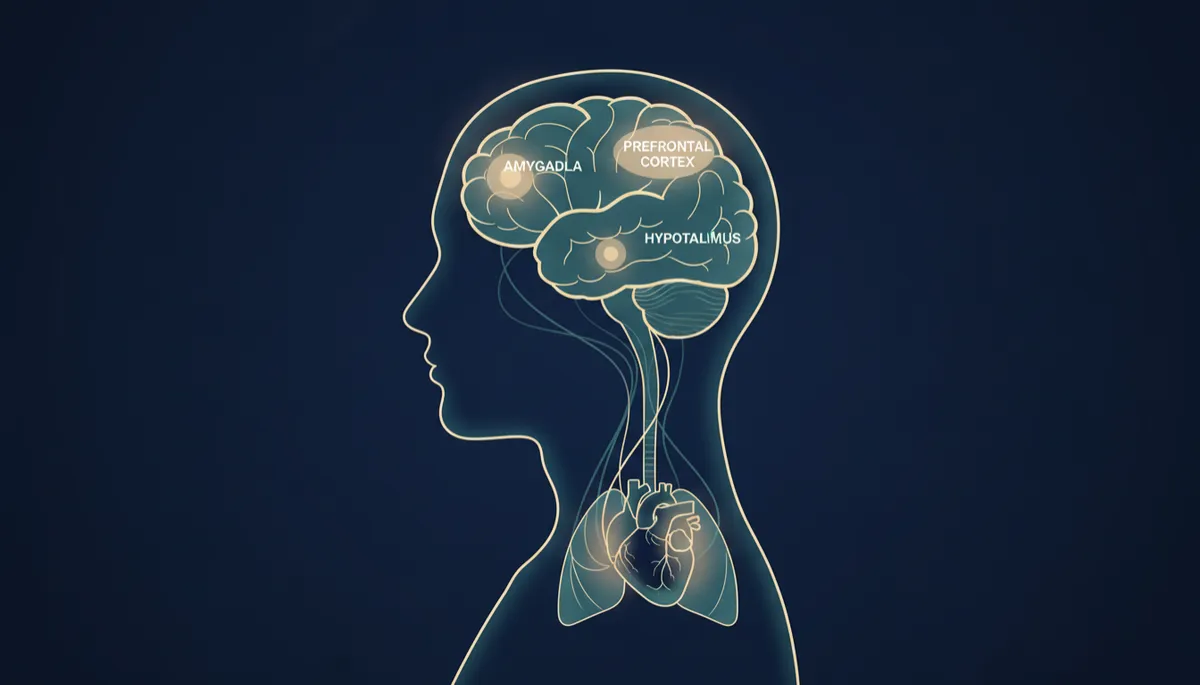
Multiple brain regions and body systems work together in the stress response.
What You Feel: Attention, Heart Rate, Breathing, and Muscle Tension
Once the brain stress response switches on, your body quickly follows. Many common stress symptoms are simply your nervous system trying to help you cope with a challenge.
Attention narrows: Your brain may lock onto the problem. You might find it hard to think about anything else, or your mind may jump between worries. This is your system scanning for “What do I need to do right now?”
Heart rate increases: Stress hormones tell your heart to pump faster, sending more blood to your muscles and brain so you can act quickly if needed.
Breathing changes: You may breathe faster or more shallowly. This can bring in more oxygen, but if breathing becomes too quick or tight, you might feel light-headed or “on edge”.
Muscle tension rises: Jaw, neck, shoulders, and back often tighten as your body prepares to move or brace. Over time, this can lead to aches, headaches, or a sense of heaviness.
None of these changes mean your brain is broken. They show that your stress response is active. The goal is not to remove this response, but to help it switch off and reset when the demand has passed.
Short-Term Stress vs Persistent Stress
Not all stress is harmful. In fact, short-term stress can be useful. It can help you meet a deadline, give a talk, or react quickly while driving. In these cases, the stress response turns on, supports you, and then settles down. Your body returns to balance.
Persistent stress is different. This is when the brain and body feel under pressure for long periods, with little chance to rest or feel safe again. You might notice:
Ongoing worry, irritability, or emotional “numbness”
Trouble falling or staying asleep, or waking unrefreshed
Frequent headaches, tight muscles, or digestive changes
Feeling “tired but wired” – exhausted, yet unable to fully relax
Research suggests that long periods of high stress can influence how brain networks function and communicate. This does not mean stress always damages the brain or that change is permanent. Brains are adaptable. With support, many people find their nervous system can become more flexible and resilient again.
Practical Ways to Support Your Brain’s Stress Response
You cannot remove stress from life, but you can help your brain and body move out of “constant alert” mode. Small, consistent practices can gently signal to your nervous system that you are safe enough to soften and recover.
1. Comfortable, Steady Breathing
Slow, comfortable breathing can support the part of your nervous system that helps you rest and digest. Aim for gentle, not forced, breaths. One simple option:
Breathe in through your nose for about 4 seconds.
Breathe out through your nose or mouth for about 6 seconds.
Repeat for 2–5 minutes, staying within a range that feels safe and comfortable.
💡 Gentle reminder: If slow breathing feels uncomfortable or triggering, shorten the practice or explore it with a health professional who understands your history.
2. Supportive Movement, Not Punishment
Movement helps use up some of the energy created by the stress response and can support mood and sleep. This does not have to mean intense workouts. Try:
A 10–20 minute walk around your neighbourhood or local park in Ashmore or across the Gold Coast
Gentle stretching before bed to ease shoulder and neck tension
Light strength or yoga-style movements that feel kind to your body
3. Sleep Habits That Support a Calmer Brain
Sleep is one of the most powerful ways your brain recovers from stress. While perfect sleep is not always realistic, small changes can help:
Keeping a fairly consistent wake-up and bedtime, even on weekends
Reducing bright screens in the hour before bed, or using warmer light
Creating a simple wind-down routine: dim lights, gentle music, stretching, or reading
4. Short Breaks to Reset Your Attention
Your prefrontal cortex works hard to focus, plan, and make decisions. Long periods of nonstop work can leave it feeling overloaded. Short, regular breaks can help your brain reset.
Step away from your screen every 60–90 minutes, even for 2–5 minutes.
Look out a window at something in the distance to relax your eyes and mind.
Take a few slow breaths or roll your shoulders to release tension.
5. Social Support: Your Nervous System Feels Connection
Humans are wired for connection. Safe, caring relationships can help your nervous system feel more settled. Even small moments of connection matter:
Talking honestly with a trusted friend or family member
Spending time with people who feel calm, kind, or grounding to you
Joining a community group, class, or activity that feels safe and enjoyable
📌 Key takeaway: You do not have to “fix” stress alone. Small, regular supports – from your own habits and from others – can gently shift how your brain responds over time.
When Might Professional Support Be Helpful?
Many people manage everyday stress with self-care, social support, and lifestyle changes. Professional support can be helpful when stress feels persistent, overwhelming, or confusing, or when it starts to affect daily life in a big way.
You feel on edge, flat, or “checked out” most days.
Sleep, work, relationships, or health are being impacted for weeks or months.
You notice strong reactions that feel out of proportion and hard to shift.
You are curious about how your brain and nervous system are functioning and would like more personalised information.
Reaching out for support is not a sign that you are failing. It is a sign that you are listening to your nervous system and seeking tools to care for it.
Neurotherapy Australia’s Brain & Nervous System Assessment
At Neurotherapy Australia in Ashmore on the Gold Coast, we offer a Brain & Nervous System Assessment for people who want a clearer picture of how their brain and body are functioning under stress and in everyday life.
What the Assessment Involves
A detailed conversation about your history, current concerns, and goals for brain health and stress management.
qEEG (quantitative electroencephalography) recording, which measures the electrical activity of your brain at the scalp. qEEG can highlight patterns in brain activity, but it does not diagnose stress, anxiety, or any mental health condition on its own.
HRV (heart rate variability) measurement, which looks at natural changes in time between heartbeats. HRV can provide information about how your autonomic nervous system is responding, but it is not a diagnostic test for specific disorders.
Our team combines this information with your story and other clinical observations. We do not rely on a single measure. Instead, we use these tools to help build a more complete picture of your brain function and nervous-system regulation, and to guide personalised recommendations. We avoid fear-based language and do not promise guaranteed outcomes, because each person’s brain and life context is unique.
FAQs: Brain Stress Response and Support at Neurotherapy Australia
Does stress always damage the brain?
No. Short-term stress is a normal part of life and can even be helpful. Long periods of high stress may influence how brain networks function, but brains remain adaptable. With the right supports, many people notice better focus, mood, and resilience over time. Our aim is not to scare you about stress, but to help you understand and work with your own nervous system.
Can a qEEG tell me if I have anxiety or another diagnosis?
qEEG cannot diagnose anxiety, depression, ADHD, or any other condition. It shows patterns of brain activity that may relate to how you feel or function, but these patterns are only one part of the picture. Any diagnosis should come from a qualified health professional using a full clinical assessment, not from qEEG results alone.
Is stress management just about “thinking positive”?
No. Thoughts do matter, but stress is also a body and brain response. Approaches that include the nervous system – such as breathing, movement, sleep routines, and connection – can work alongside mindset tools. At Neurotherapy Australia, we focus on both brain function and lived experience, not quick fixes or simple slogans.
I live on the Gold Coast. Can I access support if I’m not sure what I need yet?
Yes. Many people come to us simply feeling “not quite right” – tired, wired, foggy, or overwhelmed. You do not need a clear label to seek support. Our team in Ashmore can help you explore your concerns, discuss options, and decide whether a Brain & Nervous System Assessment or other services might be a good fit for you.
Bringing It Together: Caring for Your Brain Under Stress
When you understand what happens in the brain when stressed, your symptoms can feel less mysterious and less personal. A racing heart, tight chest, busy mind, or flat mood are not signs that you are failing. They are signs that your nervous system is working hard to protect you, sometimes for longer than it needs to.
With gentle practices – breathing, movement, sleep support, breaks, and connection – plus professional guidance when needed, many people find their stress response becomes more flexible. Over time, your brain can learn that it is safe to come out of “high alert” and spend more time in a state of calm focus and steadier energy.
Next Step: Explore Your Brain & Nervous System with Us
If you are curious about your brain stress response and would like support with stress management and brain health on the Gold Coast, our team at Neurotherapy Australia is here to help. Our Brain & Nervous System Assessment offers a structured way to explore how your brain and body are functioning – without fear-based language or quick-fix promises.
