Neuroscience of Music: Boost Brain & Nervous System
Neuroscience of music, Music and brain health, Music and nervous system regulation
The Neuroscience of Music: How Sound May Support Brain and Nervous System Regulation
How music affects the brain is more than a curiosity question. Emerging research in the neuroscience of music suggests that sound can engage key brain networks involved in attention, emotion, and stress responses. Used intentionally, music may become a simple, accessible tool to support relaxation and everyday mental wellbeing alongside other healthy habits.

Why Does Music Affect Us So Deeply?
Most people have experienced the moment when a familiar song changes the tone of a day. A few notes can bring back the feeling of a long‑ago holiday, soften the edges of a stressful commute, or give you the focus to finish a demanding task. These shifts can feel almost automatic, but they are not random. They reflect how closely music, the brain, emotions, and stress are linked.
From a neuroscience perspective, music is not just “background noise.” It is a structured stream of sound that your brain analyses in real time. As an analyst might track multiple market indicators at once, your brain tracks pitch, rhythm, harmony, and timing, then compares this incoming “data” with your memories, expectations, and current state. The result is the rich emotional experience we recognise as music.
How Music Interacts With the Brain
The neuroscience of music shows that listening is a whole‑brain activity. Rather than lighting up a single “music centre,” sound engages several interconnected networks at once:
Auditory cortex: tracks basic features like pitch, rhythm, and volume, similar to how a chart tracks price movements over time.
Limbic and emotion networks: including regions such as the amygdala and parts of the prefrontal cortex, help attach emotional meaning to what you hear.
Reward systems: dopamine‑rich pathways respond to musical tension and release, which helps explain why certain musical moments feel so satisfying.
Memory networks: link music with autobiographical memories, so one song can instantly transport you to a specific place or time.
Attention and default mode networks: recent fMRI work from Princeton suggests that instrumental music and spoken stories activate overlapping “meaning‑making” networks, supporting imagination and internal narratives.
Intracranial electrophysiology studies published in 2026 highlight how precisely the auditory cortex encodes acoustic features and predicts what is likely to come next in a piece of music. This predictive processing can shape how engaged, settled, or stimulated you feel while listening. However, responses in other brain regions, especially those linked to complex emotion and memory, remain an active area of research rather than a closed chapter.
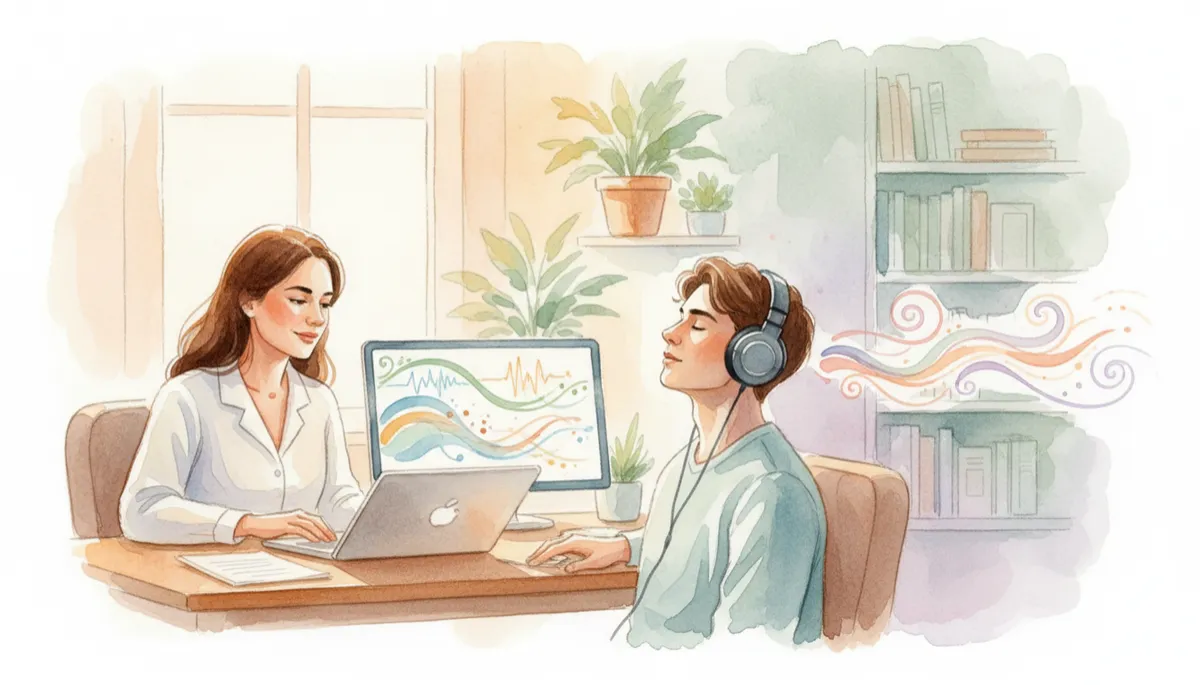
Music engages distributed brain networks, but everyday listening is different from clinical neurotherapy.
Music, Stress, and the Nervous System
Stress is not just a feeling; it is a coordinated brain‑body response. When you face a deadline or an unexpected challenge, your autonomic nervous system adjusts heart rate, breathing, and muscle tone, while hormonal systems release stress‑related chemicals. These changes are useful in the short term, but when they persist, they can affect sleep, concentration, and mood.
Research into music and nervous system regulation suggests that certain listening experiences may help some people recover from stress more smoothly. A 2026 study in Proceedings of the National Academy of Sciences found that music, more than nature sounds, reshaped connectivity between the auditory cortex, insula, and thalamus during recovery from an acute stressor. These regions are involved in monitoring internal states and regulating arousal, and the study reported faster improvements in mood and autonomic stability for participants who listened to music.
Meta‑analyses up to 2026 also point to small‑to‑moderate benefits of music‑based approaches on anxiety, depression, and emotional wellbeing, as well as modest gains in cognitive measures like memory and executive function, particularly in older adults and clinical groups. At the same time, results vary between studies, and not every trial finds strong effects. In other words, music can support stress recovery for many people, but it is not a guaranteed “switch” for the nervous system.
Can Music Help Us Feel More Regulated?
The phrase nervous system regulation is widely used, but it can mean different things in different contexts. Clinically, it may refer to measurable changes in autonomic activity, brain rhythms, or other physiological markers. In everyday life, people often use it to describe feeling calmer, more grounded, or better able to respond to what the day brings.
Feeling regulated does not mean staying relaxed at all times. Just as financial markets naturally move through periods of higher and lower volatility, healthy human systems move between states of alertness, focus, rest, and recovery. Regulation is more about flexibility: being able to shift gears and return towards a more comfortable range when the pressure eases.
Music may support this flexibility by:
providing a focal point for attention when your mind feels scattered,
gently shifting emotional tone, for example from tense to reflective, or from flat to energised,
supporting transitions between activities, such as work to home, or wakefulness to sleep.
It is important to distinguish between feeling calmer, managing emotions more effectively, and clinically changing brain or nervous system function. These are related but not identical outcomes. Listening to a favourite playlist that helps you unwind is valuable in itself, even if it does not show up as a dramatic shift on a brain scan or heart‑rate monitor.
Choosing Music With Intention
There is no single “best” genre, tempo, or frequency for nervous system regulation. Studies comparing relaxing and energising tracks suggest that tempo, predictability, and personal preference all matter, but they do not point to one universal formula. Instead, it can be helpful to match the music to your goal and context.
For relaxation: Many people gravitate towards slower, more predictable pieces with gentle dynamics. This might include instrumental, ambient, or acoustic music. The key question is whether the sound feels soothing rather than demanding your full attention.
For focus: Some listeners find that low‑distraction music, such as instrumental tracks or subtle electronic soundscapes, supports concentration on reading, writing, or repetitive tasks. Others work best in silence. A brief experiment—completing a similar task with and without music—can help you notice your own pattern.
For transitions: A short playlist can mark the shift between roles or environments, such as commuting home, closing the laptop at the end of the day, or preparing for a workout. Here, the consistency of the routine may be as important as the specific track.
For bedtime: Calmer, lower‑volume music that does not invite active singing along is often more compatible with sleep. It can be part of a wind‑down routine but should not be the only strategy if you experience ongoing sleep difficulties.
💡 Pro Tip: When exploring music and relaxation, think like a cautious investor: start small, observe your response, and adjust based on real‑world feedback rather than promises about specific “healing frequencies.”
How to Build Music Into Your Daily Routine
You do not need specialised technology to explore the neuroscience of music in your own life. Small, deliberate changes can help you notice where music genuinely supports your mental wellbeing.
Create a calming playlist. Choose 5–10 tracks you personally find soothing. Listen in a relatively quiet setting and pay attention to how your body feels before and after. If certain songs feel agitating or emotionally heavy, swap them out.
Pair music with gentle breathing. While seated comfortably, play a track you enjoy at a low volume. Allow your breath to remain natural, then, if it feels comfortable, gradually lengthen your exhale slightly. Stop if you feel light‑headed. The aim is to create a sense of ease, not to control your physiology with precision.
Use music to protect transitions. Choose one moment in your day—finishing work, returning from errands, or preparing for bed—and consistently play the same short playlist during that time. Over days and weeks, your brain may begin to associate that sound with shifting gears.
Experiment with focus sessions. Try working for 20–30 minutes with instrumental music, then repeat the same task in silence. Notice which environment supports your attention and energy. Your own data is more useful than general rules.
Allow for silence. Just as portfolios benefit from diversification, your nervous system may benefit from a mix of sound and quiet. If you notice that constant audio leaves you feeling overstimulated, intentionally include periods of silence or gentle ambient sounds in your day.
What Music Can — and Cannot — Do
The current evidence base suggests that music and brain health are meaningfully connected. Systematic reviews and meta‑analyses up to 2026 report that music‑based interventions can reduce symptoms of anxiety and depression, support aspects of cognitive performance, and assist with stress recovery in some settings, such as medical procedures or rehabilitation after brain injury.
At the same time, researchers emphasise variability. Not every study shows large effects, and not every individual responds in the same way. Music is not a guaranteed treatment for stress, anxiety, sleep problems, or other health conditions, and it should not be used as a replacement for medical or psychological care when that is needed.
📌 Key Takeaway: Think of music as a potentially helpful component in a broader wellbeing strategy—similar to movement, sleep habits, and social connection—rather than a stand‑alone cure.
Brain Health, Music, and Neurotherapy Australia
At Neurotherapy Australia, music is one part of a much larger conversation about brain health and nervous system regulation. The team is interested in how everyday experiences—such as sound, sleep, stress, and attention—relate to patterns of brain activity and functioning over time.
Clinical tools like quantitative electroencephalography (qEEG) and neurofeedback are designed to measure and work with brain activity directly. qEEG involves recording electrical activity from the scalp and analysing patterns in that data. Neurofeedback uses information about a person’s brain activity to provide real‑time feedback, supporting learning and self‑regulation over repeated sessions. These approaches are structured, evidence‑informed, and tailored to individual goals and clinical contexts.
Listening to music, even very intentionally, is not the same as undergoing neurotherapy or receiving a clinical assessment. Music can influence mood, attention, and perceived stress, but it does not diagnose conditions or provide detailed information about your brain’s electrical activity. When appropriate, Neurotherapy Australia integrates neuroscience‑informed assessment and intervention with broader conversations about lifestyle, wellbeing practices, and personal values—including how you use tools like music day to day.
Exploring Your Own Relationship With Music and Wellbeing
You do not need to become a neuroscientist to benefit from insights in the neuroscience of music. A practical way to begin is simply to notice patterns: which sounds help you unwind, which support focus, and which leave you feeling more tense or distracted. Over time, this awareness can help you build a personal “sound strategy” that complements other wellbeing habits such as movement, sleep routines, and supportive relationships.
If you are curious about deeper questions—such as how your brain responds to stress, why focus feels harder at certain times, or whether neurofeedback or other neurotherapy approaches might be appropriate—Neurotherapy Australia can help you explore those topics in more detail. Any recommendation is grounded in current evidence, an understanding of brain and nervous system function, and a respect for your individual goals and circumstances.
Conclusion: A More Intentional Way to Listen
Music sits at a unique intersection between science and everyday life. Neuroscience research shows that it engages networks involved in hearing, emotion, memory, and stress regulation. Clinical studies suggest that music and mental wellbeing are meaningfully connected, with potential benefits for mood, perceived stress, and some aspects of cognition—although results vary, and there is no universal prescription that works for everyone.
Rather than looking for a perfect playlist to “fix” stress or balance the brain, it may be more realistic—and more empowering—to approach music with curiosity. Notice how different sounds affect you. Experiment gently. Keep what helps, set aside what does not, and remember that silence is also an option. In this way, music becomes one tool among many for supporting your brain and nervous system in daily life.
If you would like to learn more about brain health, nervous system regulation, or the neuroscience‑informed services available at Neurotherapy Australia, you are welcome to reach out and start a conversation. Understanding your brain is not about chasing perfection; it is about gaining insight, exploring options, and taking thoughtful steps towards the kind of life you want to lead.
Understand your brain. Explore your options. Take the next step.
This article is for general educational purposes only and is not a substitute for personalised medical, psychological, or other professional advice. Music may complement wellbeing practices but is not a guaranteed treatment for stress, anxiety, sleep difficulties, or any health condition. If you are concerned about your mental or physical health, please seek support from a qualified healthcare professional.
Ever wonder what's going on inside your brain? Book a Brain and Nervous System Assessment today! Click here to find out more →

