Quick Stress Relief: 6 Ways to Calm Your Body
Brain Health, Stress Relief Techniques, Nervous-System Regulation
How to Down-Regulate Stress Quickly: 6 Practical Ways to Help Your Body Settle
Discover gentle, science-informed calming techniques that may help your brain and nervous system settle during stressful moments, plus when to seek extra support.
When Stress Feels Hard to Switch Off
You finish a difficult phone call, close your laptop, and tell yourself the task is done. Yet your heart is still beating faster, your shoulders are tight, and your thoughts keep replaying the conversation. Your body has not received the message that the moment has passed.
Experiences like this are common. Stress can be part of how your brain and nervous system protect you. At the same time, it can feel frustrating when you cannot simply “switch off” or relax on command, even when you want to. You might notice racing thoughts, muscle tension, difficulty concentrating, or trouble falling asleep after a busy day.
Learning how to down-regulate stress quickly is less about finding a magic off-switch and more about giving your body a series of gentle cues that it may be safe to settle. Different techniques help different people, and responses can vary from day to day. The ideas below are intended as supportive options you can experiment with, not rules you must follow perfectly.
Understanding the Stress Response: Brain, Body, and Nervous System
When your brain notices a demand, deadline, or possible threat, it helps prepare your body to respond. This can happen whether the stress is physical (such as rushing to catch a bus) or emotional (such as worrying about a conversation, bill, or exam). Much of this response is automatic and involves the autonomic nervous system, which helps regulate heart rate, breathing, digestion, and other body functions without needing your conscious attention.
Your heart rate may increase to deliver more oxygen to your muscles and brain.
Your breathing may become faster or shallower, especially in your upper chest.
Your muscles may tighten, particularly around your jaw, shoulders, neck, and stomach.
Your attention may narrow, focusing on the stressor or on “what if” thoughts.
In many situations, this response is helpful. It can give you energy to act, concentrate, or protect yourself. Problems tend to arise when the stress response is activated often, for long periods, or without enough time for recovery. You might feel “on edge” much of the day, or find that your body stays alert even when you are trying to rest or sleep.
Down-regulation is the process of helping your system move toward a less activated state when the situation allows. You are not trying to erase stress completely. Instead, you are supporting your brain and body to shift from “all systems go” toward “I can pause and take stock,” even if only by a small amount at first.
How to Down-Regulate Stress Quickly: 6 Practical Ways to Help Your Body Settle
1. Slow, Comfortable Breathing With a Gentle Exhale
Under stress, many people start breathing more quickly or holding their breath without noticing. Bringing kind attention to your breath can be a simple way to pause and create a small shift in your nervous-system regulation. The aim is comfort, not forcing extra-deep breaths or rigid counts if they do not suit you.
You might like to try:
Sitting or standing in a position where your chest and stomach can move freely, feet supported on the floor if possible.
Breathing in gently through your nose if that is comfortable for you, allowing the air to move down toward your ribs or belly without strain.
Letting your exhale be a little slower and softer than your inhale, as if you are gently sighing or breathing out through a loose mouth.
Continuing for 1–3 minutes, or for as long as it feels comfortable, without trying to “do it perfectly.”
If you feel dizzy, breathless, or uncomfortable at any point, simply return to your natural breathing rhythm and allow the exercise to end. There is no need to push through discomfort for this to be helpful.
2. Grounding Through Your Senses
Stress often pulls your attention into the future (“What if this goes wrong?”) or back into the past (“I should have done that differently”). Grounding helps bring your awareness back to the present moment through your senses. This can gently interrupt spirals of worry and help your nervous system register that, right now, you are here in this room, in this body.
A simple option is the 5–4–3–2–1 technique. You can adapt it to suit your environment:
Notice five things you can see – colours, shapes, light and shadow in the room or outside a window.
Notice four things you can feel – your feet on the floor, your clothing against your skin, the chair supporting you, or the temperature of the air on your face.
Identify three things you can hear – nearby sounds, distant traffic, birds, or the hum of an appliance.
Notice two things you can smell – your soap, your coffee, or even the neutral smell of the room.
If possible, notice one thing you can taste – perhaps a sip of water or the aftertaste of your last meal.
If five steps feel like too much, you can keep it very simple. For example, feel the weight of your body in the chair, or press your feet gently into the floor and notice how solid it is. These small anchors can help your brain register “I am here, right now,” which may support a calmer state.
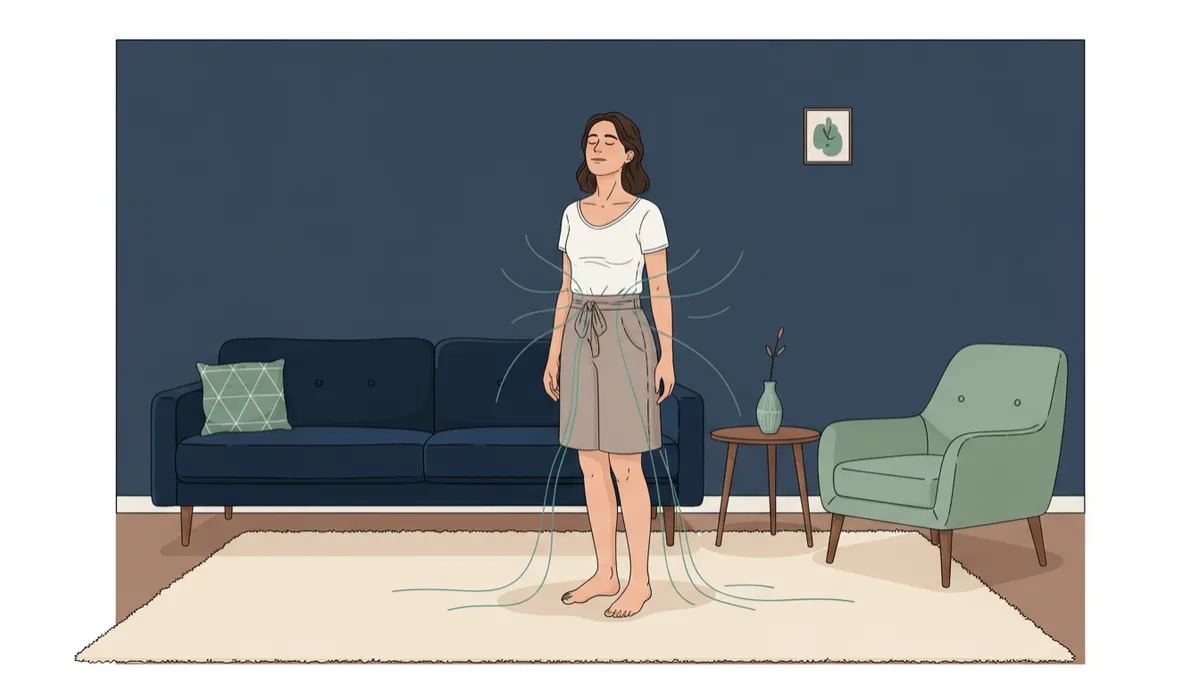
Simple sensory grounding can gently redirect attention from racing thoughts to the present moment.
3. Gentle Movement or a Short Walk
When stress builds, your body often prepares for action. If you stay very still at a desk or in a meeting while your internal systems are geared up, you may feel restless, agitated, or “stuck in your head.” Gentle movement can provide a helpful outlet and a change of context for your brain and body.
Take a short walk down the corridor, around your home, or around the block if it is safe and practical to do so.
Stand up and roll your shoulders slowly, or gently stretch your arms and back within a comfortable range of motion.
If you have been sitting for a long time, adjust your posture, move your legs, or do a few light calf raises while holding onto a stable surface.
You do not need an intense workout for this to be useful. The goal is to signal to your nervous system that you can move, look around, and engage with your environment, rather than being locked in one tense position. Over time, regular physical activity can also support sleep, mood, and stress management strategies more broadly.
4. Releasing Unnecessary Muscle Tension
Many people carry stress in their bodies without realising it. You might notice a tight jaw, hunched shoulders, clenched hands, or a tense stomach only when someone invites you to “relax,” and you suddenly realise how much you were holding. A quick body check-in can help you soften some of this extra effort where possible.
You could try the following short scan, taking your time with each step:
Jaw: Notice if your teeth are pressed together. If they are, gently allow a small space between them and let your tongue rest softly in your mouth.
Shoulders and neck: Let your shoulders drop a little away from your ears. You might roll them slowly backward once or twice if that feels good.
Hands: Uncurl any tight fists. Rest your hands on your lap, desk, or by your sides with your fingers gently open.
Stomach: Notice if you are holding your stomach in. See whether it is possible to let it soften slightly as you breathe out.
You do not need to make every muscle feel loose. Even a small shift, such as relaxing your jaw or hands, can send a different message to your brain about your current level of threat and effort. Over time, noticing these patterns can help you respond earlier, before tension builds into headaches, neck pain, or fatigue for some people.
5. Reducing Stimulation and Taking a Brief Pause
Modern life often asks your brain to process many things at once: emails, messages, notifications, background noise, and a long to-do list. When this continues for hours, your nervous system may stay in a more activated state, even if each individual demand seems small. Creating a short pocket of reduced stimulation can give your system a chance to recalibrate.
Step away from your screen for a few minutes and look at something further away, such as the horizon, trees, or a plain wall in soft colours like muted sage or warm ivory.
Silence non-essential notifications for a short period while you focus on one task at a time, if your situation allows it.
If possible, move to a slightly quieter space, or use gentle background sounds that you find calming rather than distracting.
Even a brief pause of one to five minutes can be meaningful. During this time, you might combine several techniques: slow, comfortable breathing; a quick tension scan; and a moment to notice your surroundings. The aim is not to escape your responsibilities, but to give your nervous system a small reset so you can return with a little more clarity.
6. Identifying the Immediate Stressor and Choosing One Next Step
Stress often feels most overwhelming when everything seems urgent at once. Your brain may jump between tasks, worries, and “what ifs,” making it hard to know where to start. Clarifying what is stressing you right now and choosing one manageable action can reduce this sense of overload for some people.
You might ask yourself:
“What feels most stressful to me in this moment?”
“Is there one small step I can take that would move this forward, even slightly?”
That next step could be replying to one important email, writing a short list of priorities, asking a colleague for clarification, drinking some water, or scheduling time to address the issue later. Sometimes, the most helpful next step is to pause, breathe, and decide what matters most today rather than trying to solve everything at once.
💡 Gentle reminder: You do not need to use all six stress relief techniques every time. Choosing just one or two that feel realistic in the moment can be enough to begin supporting your nervous-system regulation.
Why These Calming Techniques May Help Your Brain and Body
Each of the approaches above interacts with your stress response in a slightly different way. None of them guarantee instant relief, and they are not a replacement for addressing ongoing life pressures. However, they can support your system in gradually shifting toward a more settled state when the situation allows.
Breathing: Slow, comfortable breathing with a gentle exhale can influence parts of the autonomic nervous system involved in heart rate and arousal. Over time, this may support more flexible stress management and heart rate variability patterns for some people.
Attention and grounding: Bringing your focus to your senses or to one clear next step can reduce the mental load of constant worry. This change in attention may help your brain recognise that not every thought requires an immediate alarm response.
Movement and posture: Gentle movement helps your body use some of the energy created by the stress response. It can also provide new sensory information (such as different sights and sounds) that may signal a shift away from a high-alert state.
Environmental changes: Reducing stimulation, even briefly, can help your nervous system process what has already happened. A quieter, visually calmer space may make it easier for your brain to move from rapid scanning back toward reflection and rest.
These calming techniques are best thought of as tools in a toolkit. Some may feel more helpful than others. You might find that a technique works well on one day and feels less effective on another, depending on your sleep, health, environment, and the type of stress you are facing. This variation is normal and does not mean you are doing anything wrong.
What to Avoid When Trying to Down-Regulate Stress
When you want to feel better quickly, it can be tempting to push yourself or treat calming techniques as something you must “get right.” This can accidentally add more pressure. A few gentle guidelines may help keep your nervous-system regulation practices supportive and safe.
Do not force very deep breathing if it feels uncomfortable, makes you light-headed, or creates a sense of air hunger. Instead, aim for steady, comfortable breaths with a soft, unforced exhale.
Avoid holding your breath for long counts if it does not feel right for your body. Breath-holding practices may not suit everyone, especially without personalised guidance or if you have certain health conditions. If in doubt, speak with a healthcare professional first.
Try not to treat any single technique as a guaranteed fix. If an exercise does not shift your stress immediately, it does not mean you have failed. It may simply mean that your nervous system needs more time, a different approach, or additional support.
📌 Key takeaway: Calming techniques are invitations, not demands. If something feels unsafe, painful, or very distressing, it is important to stop and consider speaking with a qualified professional for personalised guidance.
When Stress Keeps Returning or Starts Affecting Daily Life
It is normal for stress to return, especially if the situations causing it are still present. A short walk or breathing exercise cannot remove financial pressure, relationship challenges, or demanding work environments. Instead, these techniques are there to support you in coping with those realities as you explore broader solutions where possible.
You might consider seeking professional support if you notice patterns such as:
Ongoing difficulty falling or staying asleep because your mind feels busy or your body feels tense most nights.
Frequent trouble concentrating or remembering tasks due to constant worry or mental fatigue.
Feeling on edge, irritable, or overwhelmed much of the time, even when nothing obviously stressful is happening in the moment.
Stress affecting your relationships, work performance, or ability to enjoy activities that usually matter to you.
Professional support can include your GP, psychologist, counsellor, or other qualified healthcare practitioners. They can help you explore possible contributing factors, discuss evidence-informed stress management strategies, and consider whether further assessment or treatment may be useful. You do not need to wait until you feel completely overwhelmed before asking for help.
How Neurotherapy Australia May Support Your Brain and Nervous-System Wellbeing
At Neurotherapy Australia, based in Ashmore on the Gold Coast, our focus is on brain health and nervous-system function. For some people, understanding more about their individual patterns can make it easier to choose stress management strategies that feel realistic and meaningful over time.
One way we do this is through a Brain & Nervous System Assessment. This is a personalised appointment designed to explore aspects of your brain and body activity alongside your lived experience, goals, and concerns. The specific components included can vary depending on your needs, but may involve:
qEEG brain mapping: A non-invasive method that records patterns of electrical activity from sensors placed on the scalp. This can provide information about how different areas of the brain may be functioning during rest or certain tasks, which can then be discussed in the context of your symptoms and goals.
Heart rate variability (HRV) measurement: HRV looks at the variation in time between heartbeats. These patterns can be influenced by factors such as breathing, activity levels, sleep, and recovery. HRV does not diagnose stress or mental health conditions, but it may offer insights into how your body is responding over time.
Relevant wellbeing questionnaires and discussion: Structured questions and a detailed conversation help place any recordings in the context of your daily life, history, and priorities. This can include how stress shows up for you, what you have already tried, and what you would like to change or understand better.
Together, these elements can contribute to a more complete picture of your nervous-system regulation and brain health. From there, the Neurotherapy Australia team can discuss options that may support your goals. This might include neurotherapy approaches, lifestyle strategies, or suggestions for collaboration with other healthcare providers when appropriate.
A Responsible Note About Assessment, Diagnosis, and Care
It is important to know what a Brain & Nervous System Assessment can and cannot offer. The information gathered is designed to add to your understanding and to support decision-making. It is not a standalone diagnosis of stress, anxiety, trauma, ADHD, depression, or any other condition, and it does not replace medical or psychological care.
qEEG and heart rate variability provide data about patterns in brain and heart activity, but these patterns need to be interpreted carefully, in context, and alongside clinical judgement and your own description of your experiences. They are one part of a bigger picture, not definitive labels on their own. Neurotherapy is also not presented as a cure for stress or as a replacement for other treatments recommended by your healthcare team.
⚠️ Important: If you are experiencing severe, persistent, or rapidly worsening symptoms – such as significant changes in mood, thoughts of harming yourself, or physical symptoms that worry you – please seek urgent support from a qualified healthcare professional or emergency service in your area.
Start With One Small, Manageable Step
You do not need to memorise every detail of this article or apply all six calming techniques at once. Instead, consider choosing one small action to try the next time you notice your stress rising: perhaps a minute of gentle breathing, a quick sensory grounding exercise, a short walk, or a moment to identify one manageable next step in your day.
Notice how your body and mind respond, without judging the outcome as “good” or “bad.” Over time, these small experiments can help you build a personalised set of stress management strategies that feel realistic and kind. Remember that it is normal to need extra support, especially when stress is frequent, intense, or long-lasting.
If you are curious about your own brain and nervous-system patterns, or about how neurotherapy and related approaches may fit within your broader care, the team at Neurotherapy Australia in Ashmore, Gold Coast, is available to answer your questions. A Brain & Nervous System Assessment can be a starting point for understanding what may be contributing to your experiences and what options might support your goals.
Interested in learning more? You are welcome to contact Neurotherapy Australia to enquire about Brain & Nervous System Assessment options and discuss whether they may be appropriate for you.
Location: 38/207 Currumburra Road, Ashmore QLD 4214, Gold Coast, Australia.
Frequently Asked Questions
How quickly should I expect these calming techniques to work?
Responses vary. Some people notice a small shift in a few minutes, while for others the main benefit comes from using these practices regularly over time. None of the techniques guarantee immediate relief, especially if the underlying stressors are ongoing, but they can support your system in moving toward recovery when it is able to do so.
Is it normal to feel more aware of my body when I slow down?
Yes. When you pause and pay attention, you may notice sensations or emotions that were in the background before. This is not necessarily a sign that something is wrong, but it can feel unfamiliar. If focusing on your body feels very distressing, consider shortening the exercise, keeping your eyes open, or seeking guidance from a qualified healthcare professional or therapist who can help you find approaches that feel safer for you.
Does heart rate variability show how stressed I am?
Heart rate variability reflects patterns in the timing between heartbeats and can be influenced by many factors, including breathing, movement, sleep, and overall health. HRV does not directly measure or diagnose stress, anxiety, or other conditions. Instead, it can offer additional information that may be discussed alongside your history, symptoms, and goals as part of a broader assessment.
Can neurotherapy replace my current medical or psychological treatment?
Neurotherapy is not intended to replace care from your GP, psychiatrist, psychologist, or other treating professionals. It may, in some cases, complement existing treatment plans, depending on your situation. Any changes to medication or psychological support should be discussed directly with your treating clinicians.
What should I do if calming techniques make me feel worse?
If any technique increases your distress, physical discomfort, or a sense of being unsafe, it is important to stop and return to whatever helps you feel more secure in the moment. This might include opening your eyes, changing your posture, connecting with someone you trust, or contacting a healthcare professional. You do not need to persist with a particular method if it does not feel right for you.
Ever wonder what's going on inside your brain? Book a Brain and Nervous System Assessment today! Click here to find out more →

