Regulate Your Nervous System Under Stress
Nervous System Regulation, Stress Response, Brain Health Gold Coast
How to Help Regulate Your Nervous System When Stress Hits
Discover practical, science-informed ways to support nervous system regulation when stress rises, and learn how understanding your individual brain patterns may help you create more opportunities for recovery and wellbeing on the Gold Coast.
Your heart is beating faster. Your shoulders are tense. Your thoughts are moving quickly, and everything suddenly feels like it needs your attention at once. For many people on busy days across the Gold Coast, this pattern is familiar. These sensations can be normal responses when your brain detects stress, pressure or demand. They are part of how your nervous system prepares you to respond, not a sign that you are “failing” at coping.
You cannot always remove the source of stress. Work, family, health and life circumstances are not always within your control. What you may be able to influence, at least a little, is how your body responds in the moment. Simple, accessible nervous system regulation techniques can sometimes help your physiology begin to shift away from a highly activated state toward greater steadiness and recovery. They are not quick fixes or guarantees, but they can be valuable tools for stress management, emotional regulation and overall mental wellbeing.
What Happens When Your Nervous System Detects Stress?
Your brain and autonomic nervous system work together continuously, even when you are not aware of it. The autonomic nervous system helps regulate heart rate, breathing, digestion and many other functions. It has two main branches often discussed in stress physiology:
The sympathetic nervous system, which supports activation and prepares you to respond to challenges.
The parasympathetic nervous system, which supports rest, digestion and recovery.
When your brain interprets something as a threat, pressure or important demand, it can increase sympathetic activity. You might notice:
A faster heart rate or stronger heartbeat
Faster or shallower breathing, or a sense of “tight” breathing
Muscle tension in your jaw, shoulders, neck or back
Increased alertness or feeling “on edge”
Sweating or feeling warmer than usual
Changes in digestion, such as “butterflies” or a tight stomach
Narrowed attention, where your focus locks onto the perceived problem
These stress responses are designed to be protective. They help you act quickly, pay attention and mobilise energy. On their own, they do not automatically indicate a health problem. The difficulty often arises when your nervous system spends long periods in this heightened state, or when it feels hard to return to a more settled baseline. This can affect brain health, emotional regulation, sleep and overall mental wellbeing over time.
Can You Really Regulate Your Nervous System Quickly?
Online, you may see claims about “instant nervous system resets” or techniques that promise to switch off stress in seconds. From a neuroscience and stress physiology perspective, this is an oversimplification. You may be able to influence your physiological state within minutes, but there is no single universal method that works for everyone, every time, in every situation. Nervous system regulation is more about direction than perfection—a gradual shift toward conditions that support recovery rather than a sudden on/off switch.
Different people respond differently to the same strategy. What feels calming for one person may feel uncomfortable or activating for another. Your history, current health, environment and individual brain patterns all contribute to your stress response. The realistic goal is not to force yourself to become completely calm on demand. Instead, it is to:
Notice when your stress response is rising or staying high.
Use simple strategies that may help your body move a little closer to balance.
Support your brain health and mental wellbeing over time, not just in one moment.
For some people, even a small shift—feeling 10–20% less overwhelmed, for example—can make it easier to choose the next helpful step, speak more clearly, or pause before reacting. This is where gentle, accessible nervous system regulation techniques can play a role in everyday stress management and emotional regulation.
Try This: Slow Your Breathing
Breathing sits at the intersection of automatic and voluntary control. Your autonomic nervous system manages your breath without you thinking about it, but you can also choose to change your breathing pattern. This makes breathing a practical entry point for nervous system regulation. Research suggests that slower, more measured breathing can support parasympathetic activity for some people, which may help the body move toward a calmer physiological state.
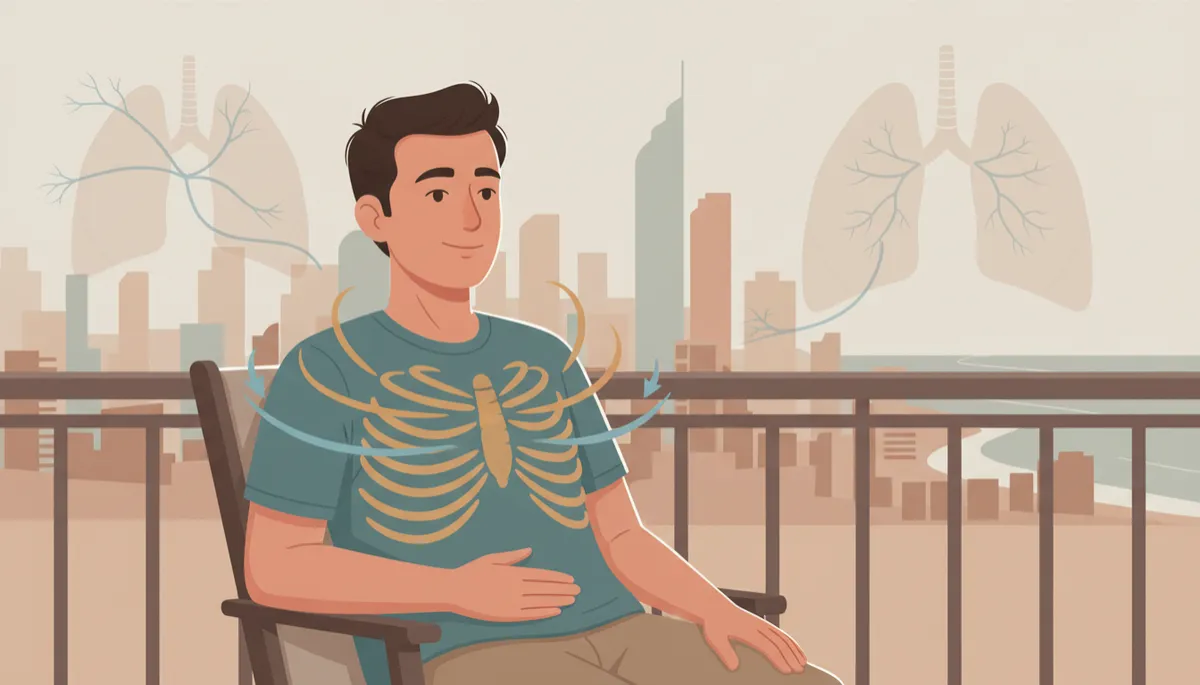
Slow, comfortable breathing can send the body a gentle signal that immediate danger may have passed.
When stress hits, your breathing may become faster, shallower or more held without you realising. Rather than forcing big “deep breaths,” which can sometimes feel uncomfortable or even increase dizziness, consider a gentler approach:
Sit or stand in a comfortable position, with your feet supported if possible.
Soften your shoulders and jaw as much as feels comfortable.
Breathe gently through your nose if that feels okay for you. If not, breathing softly through your mouth is fine.
Allow your exhale to be slightly longer than your inhale—without counting or straining. Think “easy out-breath.”
Continue for several comfortable breaths, noticing the gentle movement of your chest or abdomen.
⚠️ Important: If you feel dizzy, breathless, uncomfortable or distressed while changing your breathing, stop the exercise and return to your natural breathing pattern. These techniques are optional tools, not requirements.
For some people, this simple breathing adjustment can help reduce feelings of anxiety and overwhelm, or make it easier to engage in the next helpful step, such as talking to someone, making a decision or taking a short break. It is one of many possible nervous system regulation techniques and is not a treatment for anxiety or other mental health conditions on its own, but it can be a practical part of a broader stress relief toolkit.
Use Your Senses to Come Back to the Present
When stress is high, your attention often shifts into the past or future—replaying what happened, or worrying about what might happen. Grounding is a term used to describe practices that gently bring your focus back to the present environment, using your senses. This can sometimes interrupt repetitive thought loops and help your nervous system register that, in this moment, you may be physically safe enough to pause.
You might experiment with:
Seeing: Gently look around and name five things you can see—shapes, colours, objects, light and shadow. On the Gold Coast, this might be the pattern of waves, the outline of buildings or the way light falls on trees.
Hearing: Notice three sounds—nearby voices, distant traffic, birds, or the hum of an air-conditioner. You do not need to like the sounds; you are simply noticing them.
Touch: Feel your feet on the ground, the weight of your body on the chair, or your hands resting on your legs. You might notice temperature, texture or pressure.
Smell: Gently notice any scents—coffee, food, fresh air, the ocean, or even the absence of a strong smell.
Grounding is not about forcing yourself to feel calm or positive. It is about offering your brain concrete, present-moment information. For some people, this can reduce the intensity of racing thoughts just enough to support emotional regulation and decision-making. It is not a treatment for anxiety or trauma-related conditions, but it can be a gentle, low-risk strategy to include in everyday stress management.
Move Your Body Gently
Stress lives in the body as well as the mind. When your nervous system is activated, you may notice restlessness, pacing, fidgeting or tight muscles. Gentle movement can help use some of the mobilised energy and provide a different focus for your attention. It can also support circulation, joint mobility and overall brain health when practiced regularly as part of a balanced lifestyle.

Even a few minutes of gentle movement can help some people shift out of a stuck stress response.
Take a short walk, even if it is just around your home, office or garden.
Stretch your arms overhead, roll your shoulders or gently move your neck within a comfortable range.
Change posture—stand if you have been sitting for a long time, or sit if you have been on your feet.
Step outside briefly to feel fresh air or natural light, if available.
The intention is not to complete an intense workout. Instead, gentle, accessible movement can support nervous system regulation by giving your body a safe way to use some of the energy created by the stress response. Over time, regular movement is also associated with benefits for brain health, mood and mental wellbeing. If you have existing health conditions, seek guidance from an appropriate health professional about what types of movement are safe for you.
Reduce the Input
Many people think of regulation as something you do—another exercise, another technique, another task. However, nervous system regulation is also about what you stop doing, at least briefly. When your brain is already processing multiple demands, notifications, noises and decisions, reducing input can be a powerful form of stress relief. It gives your nervous system fewer signals to track and can support recovery after periods of activation.
Step away from a noisy environment, even for a couple of minutes, if safe to do so.
Put your phone down and turn the screen face-down, or use “Do Not Disturb” for a short period.
Close unnecessary browser tabs or apps that are not essential right now.
Take a short break from work tasks—stand up, stretch, or look out a window without trying to solve anything.
💡 Pro Tip: Even a one- or two-minute pause between tasks can create a small “reset window” for your nervous system, especially when combined with slower breathing or grounding through the senses.
On the Gold Coast, this might mean stepping outside to briefly notice the sky, trees or water, or simply moving to a quieter corner of your home or workplace. Reducing sensory and cognitive input is not avoidance—it is a deliberate stress management strategy to support your brain’s capacity to process information and recover.
Regulation Isn’t About Being Calm All the Time
It can be easy to assume that a “well-regulated” nervous system is always calm, peaceful and unbothered. In reality, a healthy nervous system needs both activation and recovery. You require alertness to drive, focus to work, energy to exercise and responsiveness to care for others. These states all involve some level of activation in your stress response systems.
A more helpful way to think about nervous system regulation is: Activation when needed. Recovery when possible. The aim is not to eliminate stress, but to build flexibility—your ability to move between states of activation and rest in a way that matches what is happening in your life. This flexibility supports emotional regulation, decision-making and long-term brain health.
When activation rises, can you notice it? Can you create a small pause before reacting? Can you use one of the simple strategies above—breathing, grounding, gentle movement, or reducing input—to support a gradual shift toward recovery once the immediate demand has passed? Over time, these small choices can contribute to more stable mental wellbeing, even when life remains busy or challenging.
What If You Feel Stressed All the Time?
Many people describe feeling as though their “stress switch” is stuck on. They may wake up already feeling tense, or notice that even small changes feel overwhelming. In these situations, it can be helpful to zoom out and consider the broader context of your life and health. Persistent stress and difficulty returning to a more settled state can be influenced by many interacting factors, including:
Sleep: Irregular or insufficient sleep can make the nervous system more reactive and reduce resilience to daily stressors.
Work demands: High workload, shift work or ongoing uncertainty can keep your stress response activated for long periods.
Relationships: Conflict, caregiving responsibilities or social isolation can all influence how your nervous system feels day to day.
Lifestyle: Nutrition, movement, screen time and substance use can affect brain health and stress responses.
Physical health: Pain, medical conditions or hormonal changes may contribute to feeling more easily overwhelmed.
Mental health: Experiences of anxiety, low mood or other mental health challenges can influence how your nervous system responds, and may require professional assessment and care.
Environment and life circumstances: Financial pressure, housing changes, caregiving roles or ongoing uncertainty can all play a role.
If you feel stressed almost all the time, it does not mean you are weak or “bad at coping.” It may simply indicate that your nervous system is carrying a lot, and that additional support could be helpful. Speaking with an appropriately qualified healthcare professional can help you explore potential contributors and consider evidence-informed options for support. Simple nervous system regulation techniques can still be part of your toolkit, but they are not a replacement for medical or psychological care when it is needed.
Understanding Your Individual Nervous System
Nervous system regulation is not one-size-fits-all. Two people can experience the same event and have very different responses. One might feel energised and focused; the other might feel anxious and overwhelmed. These differences can be influenced by genetics, past experiences, current health, sleep, lifestyle and individual brain patterns. Understanding your own nervous system can therefore be a valuable part of building sustainable stress management and supporting long-term brain health.
At Neurotherapy Australia on the Gold Coast, our approach focuses on assessment, education and practical strategies, rather than quick fixes. For people interested in nervous system regulation and brain health, we offer tools that can provide additional information and context about how their brain and body are functioning. Depending on individual needs, this may include:
qEEG brain mapping: A non-invasive way of recording brain electrical activity to explore patterns that may relate to attention, activation and recovery. It does not diagnose anxiety or mental health conditions, but it can offer useful insights into individual brain function.
Heart rate variability (HRV) measurement: HRV reflects variations in the time between heartbeats and is influenced by the autonomic nervous system. Measuring HRV over time can provide information about how your body responds to stress and recovers, but it is not a diagnostic test for nervous system disorders.
Relevant wellbeing questionnaires: Structured questions about sleep, mood, focus, stress and daily functioning to help build a clearer picture of your experience.
Nervous-system education: Clear, accessible explanations about how your brain and autonomic nervous system respond to stress, and how regulation techniques may support recovery over time.
Personalised brain training and nervous-system training: Tailored strategies designed to support more flexible patterns of activation and recovery, based on your individual assessment results and goals.
These tools are not used to diagnose stress, anxiety or mental health conditions. Instead, they contribute to a more detailed understanding of how your brain and nervous system are functioning in your current context. The Brain & Nervous System Assessment at Neurotherapy Australia brings these elements together to provide personalised information and help guide practical next steps—whether that involves self-care strategies, further assessment, or targeted training and support.
Our clinic is located at 38/207 Currumburra Road, Ashmore QLD 4214, Gold Coast, Australia. For people living and working across the Gold Coast, this can provide a local option for exploring nervous system regulation and brain health in more depth.
When to Seek Professional Support
Simple strategies such as slow breathing, grounding, gentle movement and reducing input can be valuable tools for many people. However, they are not a substitute for professional medical or psychological care. It is important to seek support from an appropriately qualified healthcare professional if:
Stress feels persistent, severe or unmanageable most days.
Anxiety, low mood or emotional changes are affecting your relationships, work or daily functioning.
Sleep is consistently disrupted, and you wake feeling unrefreshed or exhausted.
Physical symptoms such as chest pain, shortness of breath, dizziness or pain are concerning you—these should be discussed with a medical practitioner promptly.
If you are experiencing a mental health crisis, thoughts of self-harm, or feel that you or someone else may be in immediate danger, please seek urgent professional support through emergency services or crisis helplines available in your area. Nervous system regulation techniques are not designed for crisis situations and should not delay access to emergency care.
You Don’t Need to Eliminate Every Source of Stress
Life on the Gold Coast, like anywhere else, includes deadlines, family responsibilities, health challenges and unexpected changes. You do not need to eliminate every source of stress to support nervous system regulation, brain health and mental wellbeing. Instead, you can focus on creating more moments of choice and recovery within the reality of your life.
Sometimes the first step is small:
Pause: Notice that your stress response is active. Acknowledge it without judgment.
Breathe: Take a few comfortable, slower breaths with a gentle focus on the exhale.
Notice: Use your senses to connect with the present environment and your body.
Recover: When possible, create a little more space—through movement, reducing input, or taking a short break.
At Neurotherapy Australia, we support people who want to understand their individual brain and nervous-system patterns more deeply. Our Brain & Nervous System Assessment offers a structured way to explore how your brain and body respond to stress, and how personalised strategies may support greater flexibility, recovery and resilience over time.
Regulation is not about never feeling stressed. It is about understanding your responses and creating more opportunities for recovery—one small, informed choice at a time.
Ever wonder what's going on inside your brain? Book a Brain and Nervous System Assessment today! Click here to find out more →

