Stress Relief: Calm Your Brain and Body
Neuroscience, Nervous System Regulation, Stress Relief
Stressed? Try This: Simple Ways to Help Your Brain and Body Settle
Discover how your brain and nervous system respond to stress, and explore gentle, evidence-informed ways to support recovery, nervous system regulation and brain health on the Gold Coast.
Your thoughts are racing. Your shoulders are tight. You can feel your heart working a little harder than usual. Even when you finally sit on the couch at home on the Gold Coast, your mind is still at work, replaying conversations and tomorrow’s deadlines.
In these moments, being told to “just calm down” can feel almost impossible. That’s because stress is not only a story in your mind. It is a whole-body response, led by your brain and autonomic nervous system, designed to help you respond to challenge and change.
So what if the first step isn’t trying to think your way out of stress, but instead giving your nervous system a different signal? Simple, well-chosen actions may help your brain and body shift from constant activation toward moments of recovery and regulation.
What Actually Happens When You’re Stressed?
Your brain is always scanning for what matters: a tight deadline, a difficult email, a crying child, a bill you weren’t expecting, even a memory or worry about the future. When it detects something that might require extra effort or protection, it can activate your stress response.
A key player here is the autonomic nervous system, which helps regulate your heart rate, breathing, digestion and other automatic functions. One branch, often called the “fight or flight” system, can increase alertness and prepare you to act. Another branch supports rest, digestion and recovery. Healthy nervous system regulation involves both, shifting depending on what you need in the moment.
Your heart rate may increase to deliver more oxygen and fuel to your muscles and brain.
Your breathing may become faster or shallower to support that extra demand.
Muscles in your shoulders, jaw or back can tighten, ready to move or brace.
Digestion may slow as your body temporarily prioritises dealing with the perceived challenge.
Your attention can narrow in on potential problems, making it harder to notice anything else.
None of this is “bad” in itself. In many situations, these changes are normal and protective. They help you meet a deadline, drive safely in heavy traffic on the Pacific Motorway, or respond quickly when a child calls out from another room. Stress becomes more challenging when your body does not have regular opportunities to return toward a more settled state afterwards.
Why It Can Be Hard to Just “Calm Down”
You might recognise the pattern: you tell yourself, “I need to stop stressing”, but your body doesn’t seem to get the message. That’s because once your stress response is activated, your physiology can stay switched on for a while, even when the original trigger has passed.
Thoughts, physical sensations, your environment and your previous experiences all play a role. For example, if you have gone through a demanding period at work, or a period of poor sleep, your system may become more sensitive to smaller everyday challenges. A minor email can feel like a major threat when your body is already close to capacity.
Importantly, you cannot consciously control every nervous-system response. You can’t simply decide for your heart rate to slow or your muscles to release tension on command. However, you can often influence your system indirectly through your breathing, your posture, your movement and the way you interact with your environment. For some people, these small shifts can create a little more room for emotional regulation and clearer thinking.
💡 Key idea: Instead of forcing yourself to “relax”, it may be more helpful to gently change the signals your brain and body are receiving.
Try This First: Slow Your Breathing
Breathing is one of the most direct ways you can influence your autonomic nervous system. When stress rises, many people begin to breathe faster or higher in the chest, often without realising. Gently adjusting your breathing pattern may help some people move toward a calmer state, especially when combined with other strategies.
A Simple, Comfortable Breathing Practice
Sit comfortably. Rest your feet on the floor if possible. Let your hands rest on your lap or by your sides.
Soften your jaw and shoulders. You don’t need to force anything; just notice if you can release a little unnecessary tension.
Breathe gently through your nose if comfortable. Allow the breath to be natural rather than exaggerated.
Let your exhale be slightly longer than your inhale. For example, you might breathe in for a count of three and out for a count of four or five, as long as it feels easy for you.
Continue for several comfortable breaths. You might try this for one to three minutes, or less if that feels better for you.
The aim is not to force “deep breathing” or to push through discomfort. Instead, you are offering your nervous system a slower, steadier rhythm that may support a shift toward recovery for some people. If you notice dizziness, discomfort or unusual breathlessness, stop and return to your normal breathing pattern. If symptoms persist, seek medical advice.
📌 Key takeaway: Gentle, slightly slower breathing is one accessible nervous system regulation technique. It is not a cure-all, but it can be a helpful starting point for many people.
Bring Your Attention Back to the Present
During stressful moments, your mind often races into the future: “What if this goes wrong?” or “How will I cope if this continues?” While planning is important, constant mental rehearsal can keep your body in a state of ongoing alertness. Grounding and sensory awareness practices invite your attention back to what is actually happening right now.
A Simple Grounding Check-In
Look around. Gently name five things you can see in the room or outside your window on the Gold Coast skyline or trees.
Listen. Notice three sounds you can hear—perhaps distant traffic, birds, or household noises.
Feel. Notice the sensation of your feet against the floor, the chair supporting you, or your hands resting on your legs.
You are not trying to erase the stressful situation or ignore important problems. Instead, you are giving your brain present-moment sensory information to work with. For some people, this can interrupt repetitive thought loops and create just enough space to choose a next step more deliberately. Grounding does not treat anxiety or mental health conditions, but it can be a useful skill alongside other supports.
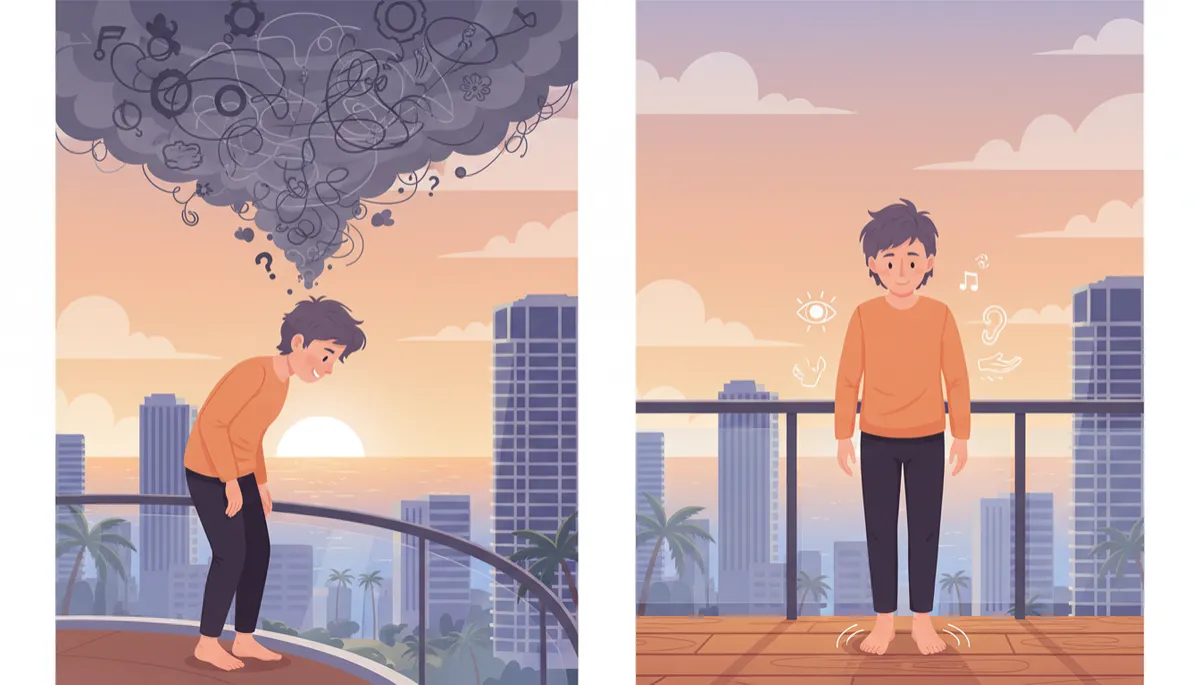
Grounding through sight, sound and touch can gently anchor attention in the present moment.
Move Instead of Staying Stuck
Stress is not only a mental experience; it is also a physical one. You might notice restlessness, tightness or a sense of being “wired but tired”. Gentle movement can offer your nervous system another way to shift state, without needing to push into intense exercise if that doesn’t feel right for you at the time.
Take a short walk around the block, along the beach or even just down the hallway.
Roll your shoulders, gently stretch your neck within a comfortable range, or stand up and change your posture.
Try a few minutes of light mobility—such as ankle circles, wrist rolls or gentle side bends—while you wait for the kettle to boil.
Movement does not need to be impressive to be useful. For some people, simply standing up and walking to a different room can create a small but meaningful reset. As always, work within your own physical capacity and any medical guidance you have received.
Reduce the Noise
When people think about nervous system regulation techniques, they often imagine adding something: a new app, another practice, another routine. Yet one powerful option is to subtract stimulation. If your brain is already processing emails, messages, news alerts and social media, more input can keep your system on high alert.
Put your phone in another room for ten minutes while you make a cup of tea or step outside.
Turn off non-essential notifications, especially in the evening when your body is preparing for sleep and recovery.
Move to a quieter space, even briefly, if you can—stepping onto a balcony, into a garden or simply away from a busy room.
Reducing incoming stimulation does not remove life’s pressures, but it can create a little more space in your attention. That extra space may make it easier to notice what your body needs next: a breath, a stretch, a conversation, or professional support.
Don’t Try to Eliminate Stress
It can be tempting to see stress as the enemy and aim for a life that is completely calm. Yet stress itself is not inherently harmful. In many cases, a certain level of activation can support focus, learning and performance. The more important question is whether your body also has enough opportunities for recovery.
You might think of your day as a series of cycles: Activation → Recovery → Activation → Recovery. Your nervous system increases alertness when needed, then—ideally—returns toward a more settled baseline when the demand has passed. This ability to shift between states is sometimes described as nervous system flexibility.
💡 Pro Tip: Instead of asking “How do I get rid of stress?”, you might ask “How can I build more moments of recovery into my day?”
Recovery doesn’t have to be dramatic. It might involve a consistent sleep routine, short breaks between meetings, time in nature, meaningful connection with others or a few minutes of quiet before bed. Over time, these small practices may support more sustainable nervous system regulation and brain health.
What If Stress Keeps Coming Back?
If you feel like you are constantly on edge, it is understandable to wonder what is going on. Repeated or ongoing stress can have many contributors, and it is rarely just one thing. Factors may include:
Disrupted or insufficient sleep
Work demands, shift work or job insecurity
Relationship difficulties or caregiving responsibilities
Lifestyle factors such as nutrition, alcohol use or lack of movement
Physical health conditions or ongoing pain
Mental health concerns, past experiences or ongoing life circumstances
It is important not to reduce every symptom to “nervous-system dysregulation”. While nervous system regulation techniques can be valuable, persistent or severe stress may signal that additional support is needed. If your stress is ongoing, intense or significantly affecting your sleep, work, relationships or daily functioning, consider speaking with an appropriately qualified healthcare professional, such as your GP or a registered mental health practitioner.
Understanding Your Own Brain and Nervous System
People do not all respond to stress in the same way. One person may feel wired and restless, another flat and exhausted. Some people find that breathing practices help quickly; others notice more change through movement, routine or structured support. Understanding your individual patterns can provide useful context for how you approach nervous system regulation and stress relief.
At Neurotherapy Australia on the Gold Coast, our focus is on assessment, education and personalised training designed to help people better understand their own brain and nervous system. Depending on individual needs, this may include:
qEEG brain mapping – measuring and mapping electrical activity at the scalp to provide insight into brain patterns and how they may relate to attention, arousal and other functions.
Heart rate variability (HRV) measurement – assessing patterns in the time between heartbeats, which can provide information about autonomic nervous system activity and recovery capacity.
Relevant wellbeing questionnaires – exploring sleep, mood, stress and lifestyle factors that may be contributing to how you feel day to day.
Nervous-system education – helping you understand how your brain and body respond to stress, in language that makes sense for you.
Personalised brain training and nervous-system training – structured approaches that aim to support more flexible regulation over time, tailored to your assessment findings and goals.
These tools are designed to provide information and guidance. They are not used to diagnose mental health conditions or to label you. Instead, they can help build a clearer picture of how your brain and nervous system are functioning, and how that might relate to your experience of stress, focus, sleep or recovery.
Neurotherapy Australia’s Brain & Nervous System Assessment is a personalised assessment designed to help you understand your individual patterns and consider practical next steps. For many people, simply having a clear, neuroscience-informed explanation of what might be happening can feel grounding in itself.

Personalised brain and nervous-system assessments can provide context for more targeted stress regulation strategies.
When Should You Seek Professional Support?
Simple practices like breathing, grounding and gentle movement can be valuable, but they are not a substitute for healthcare. It may be time to seek professional support if stress is:
Persistent, lasting for weeks or months without much relief
Severe or overwhelming, making it hard to cope with daily tasks
Significantly affecting your sleep, appetite or energy levels
Interfering with your work, study or ability to concentrate
Impacting your relationships or your capacity to connect with others
Reaching out for help is not a sign that you have failed to manage stress. It is often a wise, proactive step in caring for your brain health, nervous system and overall wellbeing. Your GP can be a useful first point of contact, and may work alongside psychologists, psychiatrists or other health professionals as needed.
If you are ever in crisis, feeling unsafe or at immediate risk of harm, please seek urgent support through local emergency services or crisis helplines in your area.
You Don’t Have to Solve Everything at Once
When stress builds, the instinct is often to do more—solve every problem, answer every message, plan for every possible outcome. Yet sometimes the most helpful first step is much smaller: a pause, a breath, a moment of noticing what your body is doing right now.
You don’t always need to fix the entire situation in a single moment. You can start by giving your brain and body a little more space to recover: softening your shoulders, slowing your exhale, stepping away from the screen, or walking outside to feel the air on your face. Over time, these small, repeated choices can support more sustainable nervous system regulation and emotional regulation.
If you are curious about how your own brain and nervous system are responding—and how that might relate to your experience of stress, sleep or focus—Neurotherapy Australia on the Gold Coast offers a personalised Brain & Nervous System Assessment that combines objective measurements with practical, neuroscience-informed education.
Location: 38/207 Currumburra Road, Ashmore QLD 4214, Gold Coast, Australia.
CTA – Learn more: To explore how a brain and nervous system assessment Gold Coast service may support your next steps, visit our Brain & Nervous System Assessment page or contact our team to discuss whether this is suitable for you.
Ever wonder what's going on inside your brain? Book a Brain and Nervous System Assessment today! Click here to find out more →

